

Everything I know about the behavioral health market in 2026

Behavioral health has been through an insane hype cycle — crash and rebound — over the past decade. Once the forgotten segment within our overly medicalized healthcare system, it's now the biggest driver of utilization in the $80B (and growing) virtual care delivery market. After years of pouring capital into the space — a staggering $12B+ since 2020 — we're entering an era of consolidation, exits and increasing competition among the scaled players.
There are breakouts in every category, generating hundreds of millions in revenue. And the question of the moment for companies in the space is:
How do I get even bigger without jeopardizing my core business?
In many ways, that's a great place to be — but it comes with its own challenges, which I'll outline in this piece. It’s based on dozens of conversations with payers, executives and leaders in this space, as well as years of investing in the category and advising several of the scaled players.
But first, a little history.
During the pandemic, when it finally seemed like telehealth would get the boost it needed as regulations relaxed and more patients opted to be seen outside the doctor's office, health-tech investors started hunting for opportunities. The most obvious category, in many people's minds, was behavioral health.
I — and plenty of other investors — felt buoyed by a preponderance of evidence showing that virtual mental health care could be as effective as in-person care. And it seemed that payers had come around to realizing the importance of mental health and its connection to so many other conditions. Another factor? Former AbleTo CEO and Optum exec Trip Hofer recalls “tremendous pressure” on payers from self-insured employers demanding better support for their employees during this period.
Policy-wise, momentum around opening up access to behavioral healthcare had been growing since the 1990s with the parity and equity laws, in addition to the Affordable Care Act.

|
17 · SEP · 1:00PM ET Top Employers Share What Healthcare Startups Need to Know in 2026Top employers reveal how healthcare startups can win enterprise buyers, with Nilay Shah sharing procurement priorities, purchasing decisions, outreach strategies, and ROI expectations.
|
|
|
24 · SEP · 12:00PM ET Healthcare AI Has an ROI ProblemJoin Aaron Miri, DHA, FCHIME, CHCIO, EVP and Chief Digital & Information Officer at Baptist Health, to explore how health systems evaluate AI ROI, overcome data bottlenecks, and scale emerging technology into clinical production.
|
|
|
22 · SEP · 3:30PM ET Where are AI Agents Actually Working in Healthcare, and Why?Christina Farr joins Nick Perry (Candid Health) and Robert Krayn (Talkiatry) to explore how autonomous AI agents are driving measurable financial outcomes, from billing to faster cash cycles and growth.
|
|
|
13 · OCT · 12:30PM ET Verifying AI in Medicine: Is Healthcare AI Actually Ready for Deployment?Is AI ready for real-world clinical care? Dr. Zak Kohane and Protege’s Engy Ziedan debate what it takes to safely trust AI in diagnosis and treatment, from benchmark performance and clinical evidence to whether we’re holding AI to a higher standard than humans.
|
|
Upcoming Sessions
Live conversations with the people shaping healthcare.

Is It Finally the Moment for Alternative Plan Design?
Employers are under growing pressure to control healthcare costs while improving access, outcomes, and the member experience. That has renewed interest in

Type 2 Diabetes & Cardiometabolic Care: Wearables, AI & GLP-1s
The rise of wearables, GLP-1s, and AI is reshaping treatment for Type 2 diabetes, weight loss, and metabolic disease. We have

Verifying AI in Medicine: Is Healthcare AI Actually Ready for Deployment?
Is AI ready for real-world clinical care? Dr. Zak Kohane and Protege’s Engy Ziedan debate what it takes to safely trust AI in diagnosis and treatment, from benchmark performance and clinical evidence to whether we’re holding AI to a higher standard than humans.

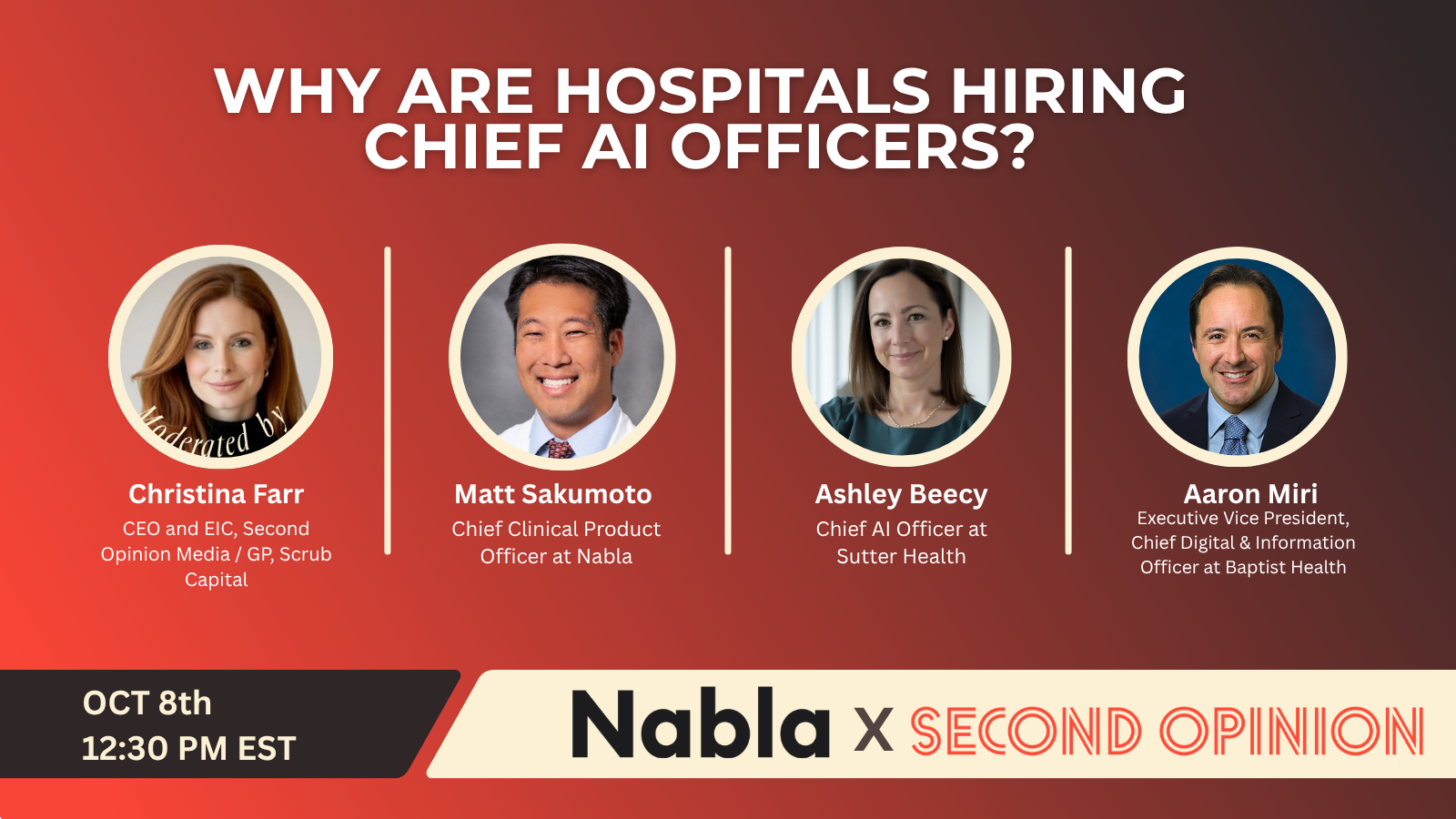
Why Are Hospitals Hiring Chief AI Officers?
As AI moves from pilots into day-to-day healthcare operations, health systems are having to decide who should actually own the


Where are AI Agents Actually Working in Healthcare, and Why?
While the healthcare industry remains locked in a high-level debate over the theoretical potential of artificial intelligence, a select group of

Top Employers Share What Healthcare Startups Need to Know in 2026
As enterprise health purchasers face volatile medical cost trends and tightening operational margins, the standard vendor pitch of "improved clinical efficiency&

Peptide Therapy: Where Do We Go From Here?
Watch the full webinar Peptide therapies have moved from niche biohacking circles into mainstream medicine, reshaping conversations around weight management, metabolic health,

Not everyone can access the top 1% of physicians. Will AI change that?
Historically, top-tier medical expertise was limited by wealth and geography. As AI reshapes healthcare delivery, a vital question emerges: can it democratize intelligence to give everyone access to the caliber of care typically reserved for the top 1%?

Privacy AI and the Future of HIPAA
Watch the Full Webinar As AI reshapes healthcare and more patient data flows beyond traditional clinical settings, the rules governing privacy, access,