

Doctors get into the ring about AI’s potential in healthcare


The debate on whether or not AI can take on tasks from physicians and other care professionals is continuing to heat up. After seeing this well-publicized analysis in JAMA, I hosted the CEO of the American Medical Association, John Whyte, and bioethicist and oncologist Zeke Emanuel for a very spicy debate. Emanuel, alongside tech entrepreneur Neal Khosla and Penn Medicine’s Abe Baker-Butler, co-authored the study about the potential to use AI in care delivery — and not just in administrative use cases. The paper got a lot of attention because it proposed that AI could do a better job than doctors across many tasks. It wasn't a study per se, but an analysis of prior studies.
I’m personally a huge fan of the debate modality! We need more forums in healthcare to duke out the issues, versus acting like we’re always in perfect alignment. Because we’re not.
My personal takeaway?
Well, I shared some of the patient’s perspective during the episode. My view there is that a physician is still critical to remain in the loop most of the time (for now), but I see enormous opportunities to help patients self-triage at home. Most of us have to figure out whether to even see the doctor or a specialist based on a Google search or a call with a friend, and it’s extremely clear that LLMs are a much better alternative.
I also believe that AI is getting better all the time, and we should critically examine where it can be most useful. I don’t believe that our healthcare system can scale to meet the needs of a growing, aging population if we decline to do so. Many of my physician friends, including Graham Walker, seem open to the idea that AI can take on some very low-risk tasks asynchronously, as long as the AI companies are willing to take on liability. Medication refills are a good example, and we saw the first experiment with that in Utah.
I’d love to know what you think. Do you agree with Dr. Whyte? How about Dr. Emanuel? Or are you somewhere in the middle? Please drop me a line and share what you think. I’m especially hoping to hear from Dr. Mike Varshavski, who threw some shade on X about the debate but did not respond to multiple requests to join the podcast. So if anyone knows him personally, the spot is open anytime.
On a personal note, I recently returned from Seattle where I attended a summit hosted by the company Avante, including HR/benefits leaders, technologists like Babak Parvis and Dr. Andrew Trister and an appearance from the CEO of Providence Erik Wexler. You can watch the highlight reel here.
A few takeaways from the dinners, coffees, and side conversations:
- Employers are very intrigued by AI and actively using it for member education and navigation, but also seeing some impacts they’re mitigating in surprising ways. AI-generated emails where employees are asking for raises and promotions within a few weeks of starting on the job? Very much a thing.
- Employers are getting very creative about payment structures for health-tech companies. Payment “bands” are increasingly common, versus contracts based on straight utilization or engagement (too unpredictable) or PMPM (not great for employers if utilization is low).
- Employer-sponsored healthcare isn’t going anywhere, but there’s lots of interest in alternative plan design. The big question: How do you dabble and try it out without betting the farm? Included Health’s acquisition of Firefly is one to watch from that perspective.
- There’s a generally positive view of consolidation as more employer-focused companies are buying each other. No one wants yet more “point solutions,” and employers want their existing vendors to expand.
- Health systems are facing a series of crises that Providence CEO Erik Wexler was very direct about. Many leaders from the big health systems are also in active conversation with the major AI players, while also figuring out whether to work with venture-backed companies. From a technology perspective, this time seems to feel different. The winners will present actual use cases to customers and prospects, and not just capabilities.
I’m a much bigger fan of solutions that drive revenue up versus the elusive promise of downstream cost savings.
Thank you again to Avante for hosting me!
Now, onto the news…
– Chrissy

|
17 · SEP · 1:00PM ET Top Employers Share What Healthcare Startups Need to Know in 2026Top employers reveal how healthcare startups can win enterprise buyers, with Nilay Shah sharing procurement priorities, purchasing decisions, outreach strategies, and ROI expectations.
|
|
|
24 · SEP · 12:00PM ET Healthcare AI Has an ROI ProblemJoin Aaron Miri, DHA, FCHIME, CHCIO, EVP and Chief Digital & Information Officer at Baptist Health, to explore how health systems evaluate AI ROI, overcome data bottlenecks, and scale emerging technology into clinical production.
|
|
|
22 · SEP · 3:30PM ET Where are AI Agents Actually Working in Healthcare, and Why?Christina Farr joins Nick Perry (Candid Health) and Robert Krayn (Talkiatry) to explore how autonomous AI agents are driving measurable financial outcomes, from billing to faster cash cycles and growth.
|
|
|
13 · OCT · 12:30PM ET Verifying AI in Medicine: Is Healthcare AI Actually Ready for Deployment?Is AI ready for real-world clinical care? Dr. Zak Kohane and Protege’s Engy Ziedan debate what it takes to safely trust AI in diagnosis and treatment, from benchmark performance and clinical evidence to whether we’re holding AI to a higher standard than humans.
|
|
Episode 4 of Rounds is here!
The EHR is Dead, Long Live the EHR.

In Episode 4 of Rounds, Christina Farr and Stephanie Davis break down the biggest healthcare and AI headlines, from the collapse of hedge fund Situational Awareness to Epic's recent leadership shakeup, before sitting down with Sam Toole, Partner at Primary Venture Partners, and Sonia Millsom, CEO of Oxeon, to talk EHR disruption, early-stage investing opportunities, and what real succession planning looks like in healthcare.
One of our eagle-eyed readers spotted that Plushcare, the virtual care company that was acquired by Accolade, is now a subsidiary of Fabric, per a Terms of Service update. This acquisition wasn’t announced to the public, so may have occurred quietly after Accolade sold to Transcarent. Fabric is gearing up to be a larger player offering virtual care delivery services and a platform for employers, health plans and health systems. It previously acquired Walmart’s MeMD telehealth business, and is backed by firms like General Catalyst, GV and Thrive Capital.
Upcoming Sessions
Live conversations with the people shaping healthcare.

Is It Finally the Moment for Alternative Plan Design?
Employers are under growing pressure to control healthcare costs while improving access, outcomes, and the member experience. That has renewed interest in

Type 2 Diabetes & Cardiometabolic Care: Wearables, AI & GLP-1s
Register Here The rise of wearables, GLP-1s, and AI is reshaping treatment for Type 2 diabetes, weight loss, and metabolic disease.

Verifying AI in Medicine: Is Healthcare AI Actually Ready for Deployment?
Is AI ready for real-world clinical care? Dr. Zak Kohane and Protege’s Engy Ziedan debate what it takes to safely trust AI in diagnosis and treatment, from benchmark performance and clinical evidence to whether we’re holding AI to a higher standard than humans.

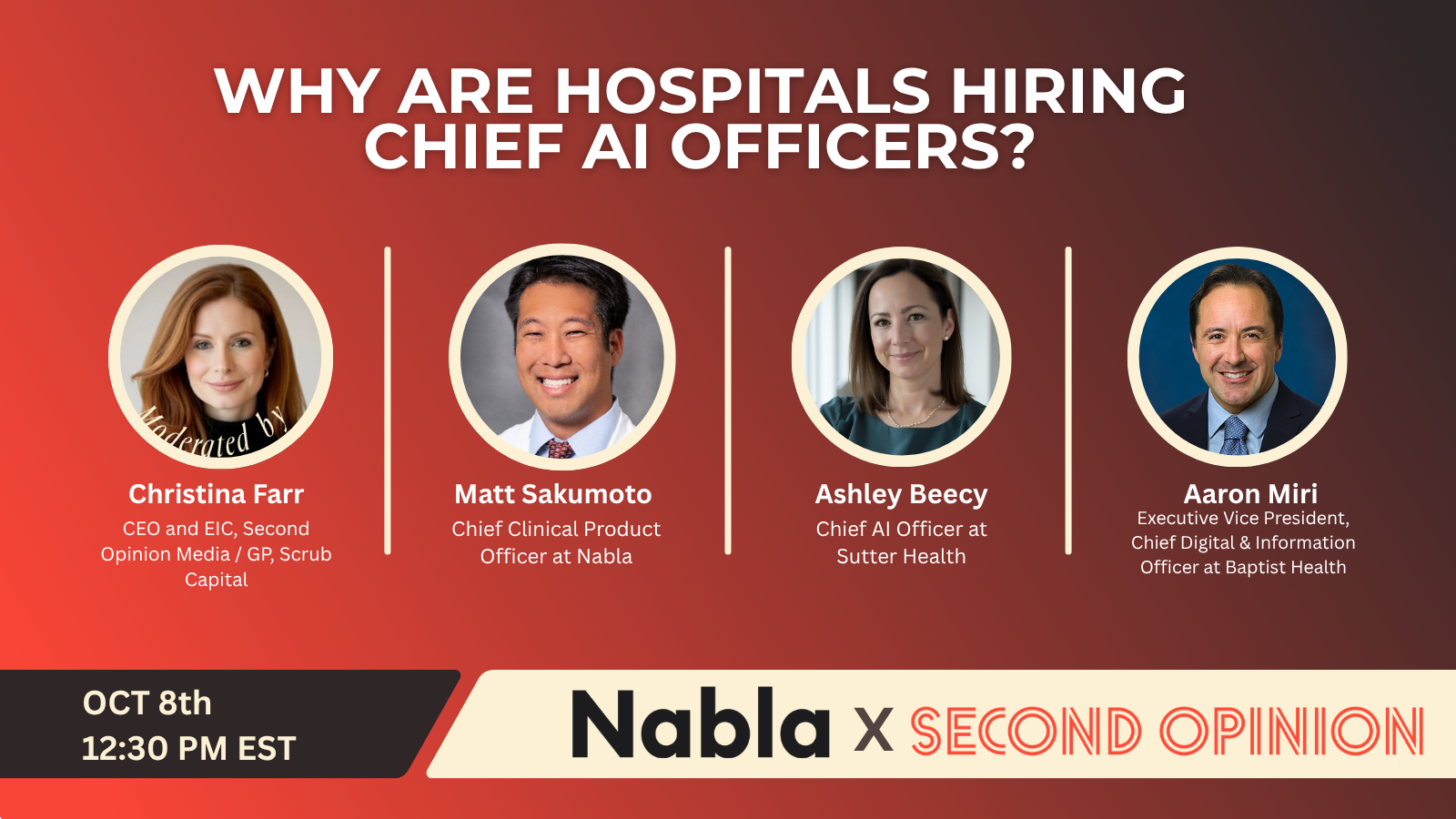
Why Are Hospitals Hiring Chief AI Officers?
As AI moves from pilots into day-to-day healthcare operations, health systems are having to decide who should actually own the


Where are AI Agents Actually Working in Healthcare, and Why?
While the healthcare industry remains locked in a high-level debate over the theoretical potential of artificial intelligence, a select group of

Top Employers Share What Healthcare Startups Need to Know in 2026
As enterprise health purchasers face volatile medical cost trends and tightening operational margins, the standard vendor pitch of "improved clinical efficiency&

Peptide Therapy: Where Do We Go From Here?
Watch the full webinar Peptide therapies have moved from niche biohacking circles into mainstream medicine, reshaping conversations around weight management, metabolic health,

Not everyone can access the top 1% of physicians. Will AI change that?
Historically, top-tier medical expertise was limited by wealth and geography. As AI reshapes healthcare delivery, a vital question emerges: can it democratize intelligence to give everyone access to the caliber of care typically reserved for the top 1%?

Privacy AI and the Future of HIPAA
Watch the Full Webinar As AI reshapes healthcare and more patient data flows beyond traditional clinical settings, the rules governing privacy, access,