

Healthcare's Newest Power Player Is the Chief AI Officer


Hospitals across the country are shaking up the C-suite by appointing chief AI officers. Like the chief innovation and chief digital officer roles that came before it, the job's scope varies widely from one health system to the next. So we at Second Opinion spent weeks speaking with the people who hold it, and the people who work with them, to understand the responsibilities, how the role is structured, and how startups can work alongside these new executives.
What we know for sure is that the role has become increasingly important as hospitals face mounting financial pressure from labor shortages, rising costs, and shrinking reimbursement. AI offers some answers, but implementing it responsibly requires someone whose full-time job is coordinating it across the entire system, from clinical care and operations to workforce training. Historically, that work has fallen to the CIO or CMIO.
In smaller healthcare organizations, it's often not practical to have a separate executive overseeing AI, says Edward Lee, MD, chief medical officer at Nabla, which has developed an ambient AI assistant used by clinicians across the country. But larger health systems have different needs, he points out, and navigating AI requires a fundamentally different skill set. With more employees, technologies, and AI initiatives to manage, many are creating dedicated chief AI officer (CAIO) roles.
Many of the new CAIOs are drawn from fields like data science and informatics. Some are new to healthcare entirely. Others were offered the role after stepping up internally and leading AI initiatives, which is a sign that there's a powerful role to play for clinicians who get smart about the technology early. Physician sentiment about AI is continuing to trend positive, per studies like this one from the AMA. But some frontline medical professionals are smarter than others when it comes to the more technical aspects of using AI, inclusive of prompt engineering.
While the CAIO title is still relatively new and varies widely from one organization to another, the role is quickly becoming a fixture in the hospital C-suite at systems like Sutter Health, Cedars-Sinai, UCLA Health, and Baptist Health. In this piece, we’ll walk you through real case studies, examples, and tactics that each of these health systems is using today.

What is a chief AI officer?
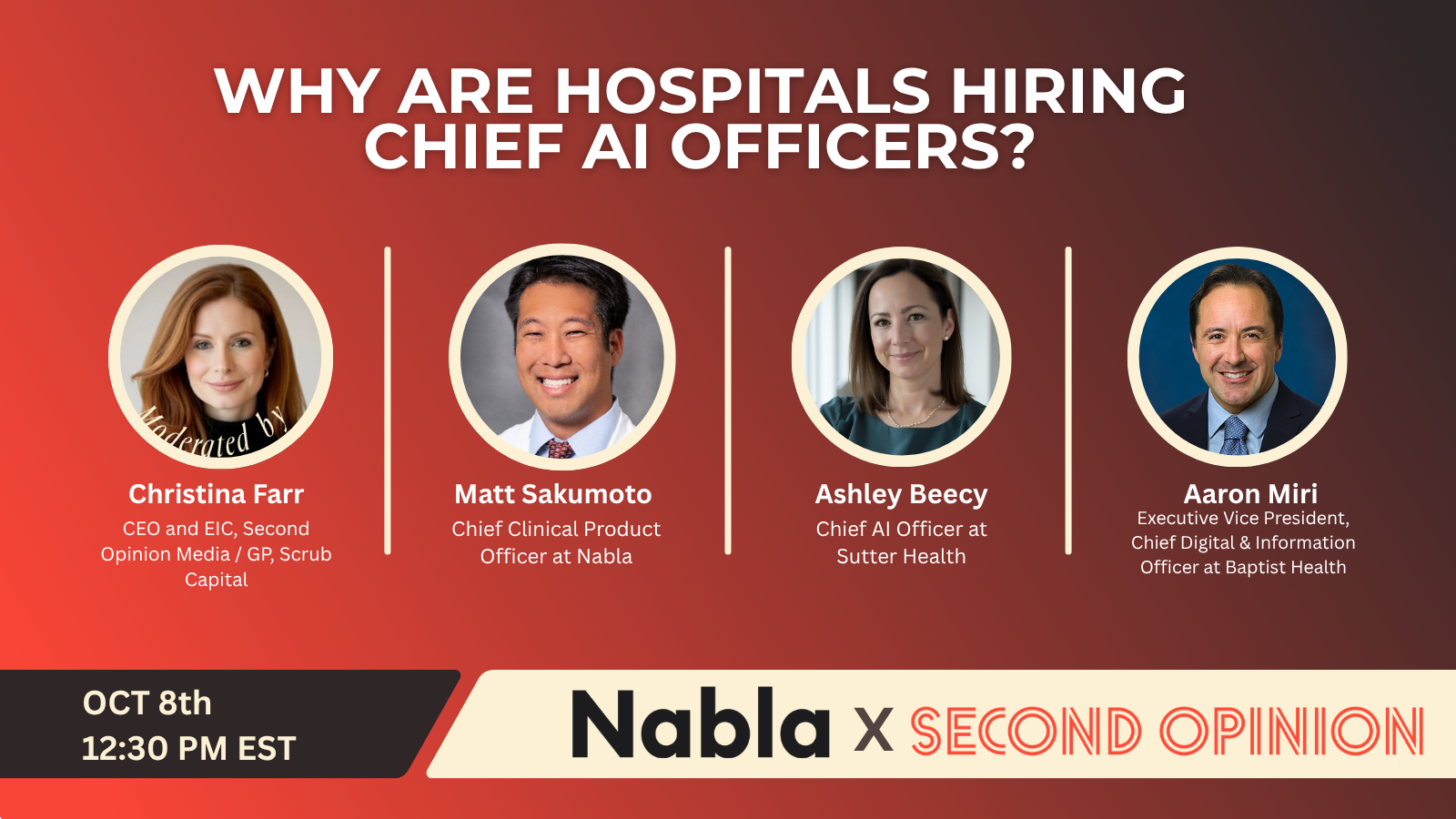
The CAIO role emerged because AI spread through healthcare so quickly that many organizations realized no one in the C-suite was responsible for thinking across its many implications, Ashley Beecy, MD, chief AI officer at Sutter Health in Sacramento, Calif., told us.
AI touches technology, clinical care, operations, regulation, risk, and strategy — all areas traditionally led by different executives. The role grew organically out of the need for somebody to take point on the work, she says, connecting leaders across the organization to understand how AI will affect their respective domains.
Collaboration and orchestration are now some of the biggest parts of her job. Beecy works closely with the chief medical information officer, chief clinical innovation officer, data and analytics leaders, as well as the clinical applications teams to understand each group's priorities and identify where AI can have the greatest impact. It was also important to Sutter that the position be filled by a physician, she shared. That means decisions about AI are grounded in how the technology ultimately affects patients. She describes AI as an "enabler," asking how it can help the organization accelerate or deliver on strategic goals in both clinical and administrative spaces, from supply chain and specialty pharmacy to radiology workflows.
Not a "tech guru"
The ideal CAIO, adds Aaron Miri, senior vice president and chief digital and information officer at Baptist Health in Jacksonville, Fla., isn't the "tech guru" explaining the latest model from OpenAI or Anthropic. Nor is it someone simply acting as a conduit for requests and ideas from employees, akin to a project manager. Instead, he says, the CAIO should have a deep understanding of healthcare operations, be able to speak the languages of both finance and clinical care, and know how to connect those worlds with AI technology. The "phenotype," he says, is an innovator who is always asking within the constraints of healthcare, inclusive of stringent privacy and security policies: "how can we do this smarter, better, faster, and cheaper?"
For Paul Lukac, MD, Chief Artificial Intelligence Officer at UCLA Health, a clinical background is the most important qualification for a health care CAIO because it provides firsthand insight into how care is actually delivered and where AI can make a meaningful difference. Only that experience enables a CAIO to tell the difference between genuinely useful AI applications that make sense for the health system versus those that fall short, he says. Another valuable role the CAIO plays is bringing a fresh perspective to AI implementation, says Matthew Sakumoto, chief clinical product officer at Nabla, who formerly practiced at Sutter. While many health systems are focused on deploying proven tools like ambient AI documentation at scale, these leaders are often well positioned to identify novel use cases, experiment with new approaches, and connect organizations with additional expertise or resources, he says. Even if those projects don't have the broadest organizational impact, explains Sakumoto, they can generate new ideas and foster the kind of cross-disciplinary collaboration that drives future advances.
As hospitals create CAIO roles, the title itself matters less than what it signals, notes Mouneer Odeh, chief data and artificial intelligence officer at Cedars-Sinai. The real question, he says, is whether a health system is building not just a leadership role, but the technical infrastructure and the culture needed to support it. Resources and budget also matter. The most powerful CAIOs have their own P&L, meaning they’re provided resources to achieve their goals through investments in technology and staffing. And like any business function, they’re held accountable.
Dr. Lukac argues that there isn’t a single set of right and wrong responsibilities for a CAIO given that every health system has different needs. But there is a wrong mindset: Treating AI as though it's a fixed, predictable technology, he says. The field is changing too quickly to create a rigid long-term strategy without expecting constant—even daily—adjustments. A successful CAIO has to be comfortable with uncertainty and transparent about what is still unknown. Acting as though all the answers already exist is setting the organization up for failure.
Different structures, similar responsibilities
Although the CAIO role looks different at every health system, Sutter, Baptist, UCLA Health, and Cedars-Sinai have all built multidisciplinary structures that spread responsibility across the enterprise.
- Miri from Baptist oversees an executive AI council composed of clinicians and leaders from legal, compliance, ethics, medical affairs, and data science. Beneath that sit clinical and operational subcommittees, plus a steering committee that evaluates ideas from across the organization before forwarding the strongest proposals for executive review.
- Sutter has created what Beecy calls the Center for Applied AI, organized around four core functions: technology enablement, innovation and industry partnerships, workforce enablement, and AI governance. Within the center, program managers, product managers, engineers, and data scientists evaluate technologies, decide whether to build or buy, oversee implementation, and monitor AI systems after deployment.
- At Cedars-Sinai, Odeh's team just finished a reorganization of its own. Previously, data engineers, business intelligence developers, and data scientists worked in separate functional silos, fielding requests the way a traditional IT service center does. That model no longer fits how AI needs to move, Odeh says. It's been replaced with multidisciplinary "pods" that combine all of those skill sets, each embedded with a specific internal customer — a hospital department or business unit — so the team lives inside that group's daily problems rather than waiting for a ticket.
- At UCLA Health, the chief data and analytics officer focuses primarily on data infrastructure and analytics, while the CMIO brings a clinical perspective with less of an AI-specific focus. Lukac bridges those functions, blending data science, pragmatic clinical research, informatics, project management, and operations. Because AI touches nearly every part of the health system, the roles operate with a shared division of labor, and the CAIO serves to thread these different verticals together.
Each leader stresses that the CAIO doesn't "own" AI. If AI is going to be central to your business, then everyone in leadership needs a foundational understanding of it, says Sakumoto — it can't be expertise siloed in one person or one department. Instead, the role serves as connective tissue across departments that have traditionally operated independently.
Deciding what's worth doing
With hundreds of AI products flooding the healthcare market, deciding what to pursue and what to pass on is a primary function of the CAIO. More AI isn't inherently better. In some cases, the best solution is a simpler technology, or even a change in workflow or staffing rather than an AI application at all. A successful AI strategy requires knowing not only where AI adds value, but where it doesn't, and making deliberate decisions about how to allocate resources.
- Cedars-Sinai has shifted toward hardwiring AI prioritization directly to the health system's strategic priorities, rather than pursuing opportunistic pilots wherever an enthusiastic partner turns up. At the same time, Odeh has pushed to democratize AI at the frontline, giving staff HIPAA-compliant self-service tools and running internal "promptathons,” which are hackathon-style competitions where employees build their own prototypes, so that lower-complexity problems get solved by the people who actually experience them. That frees his team to focus on higher-impact work. For Miri at Baptist, every proposal starts with the organization's mission, vision, and values. Some projects are evaluated on financial return, others on patient outcomes or community benefit. Baptist's AI-assisted coding initiative, for example, improved productivity for medical coders, reduced hiring needs, and generated significant savings. An internally developed algorithm that helps emergency department clinicians identify potential victims of human trafficking was driven not by cost savings but by community impact.
- Sutter asks a different but related question. Beecy says: "Does it improve the way that we care and help treat our patients?" That value can take many forms, like giving doctors more face time during a patient visit. AI-powered documentation tools, for example, allow physicians to spend less time typing and more time looking patients in the eye — to "invest in human connection," as she puts it. It also means doctors don't have to write notes at night after they go home, potentially easing some physician burnout.
But technology alone isn't enough. "Even if it might perform really well, if it's not going to be adopted or it's not going to fit seamlessly into the way people work, then it's going to fail," Beecy says. Before automating or integrating new tech into a workflow, the CAIO and team must ensure the underlying process is mature — and that the people who will use it are ready. "If you don't have a process that's clean and mature, trying to automate it doesn't work."
Roll out fast — and know when to pull the plug
Successful AI programs depend on disciplined evaluation rather than blind enthusiasm.
- At Baptist, every project begins with a defined return-on-investment analysis and a roughly three-month evaluation period. Teams decide in advance what success looks like, collect data, and either expand the project or abandon it. In three months, Miri believes, you can quantifiably have enough data to answer the question: "Is this really doing what we thought it was going to do, or is this stupid? "That approach has produced both successes and failures. Baptist rolled out AI-powered chart summarization after demonstrating it could help physicians review lengthy patient histories faster and accelerate hospital discharges. Another effort that used AI to predict patient falls didn't perform well enough and was shelved, though it later informed a different internally developed model.
- Sutter follows a similarly structured process, though Beecy describes multiple stages before full deployment: technical validation, operational testing with a small user group, workflow refinement, broader implementation, and continuous monitoring after launch. User feedback is collected through surveys, thumbs-up/thumbs-down ratings, and other qualitative and quantitative metrics. She cautions against what she calls "pilotitis" — organizations that spend years testing technologies without ever bringing them to scale. "If you're being very deliberate and intentional about what you're trying to achieve in each stage, you can move through that process pretty quickly," she says. Cedars-Sinai relies on a similar mix of head-to-head testing and disciplined patience. When evaluating ambient documentation technology, Odeh's team ran competing products side by side across different care settings, whether that’s the emergency department, inpatient units, or outpatient clinics, and standardized on whichever performed best in each before scaling it and retiring the rest. Not every idea survives that scrutiny. A promptathon-winning concept for helping nurses order medical supplies looked promising as a proof of concept but proved impractical to build as originally conceived; the team scrapped it and rebuilt it from scratch as a conversational tool that translates between clinical terminology and supply-chain terminology, which has since expanded from a pilot unit to multiple departments. Other projects simply wait. Odeh points to an internally developed sepsis prediction model that clinical and nursing informaticists were not comfortable deploying, so it continues to run in the background under evaluation rather than going live. Sometimes it takes six months or a year for the technology to catch up to the experience they're looking to deliver, he says.
Outcomes are less straightforward to measure in an AI-enabled environment than in traditional IT, Sakumoto notes, which is why having the right tools, metrics, and evaluation frameworks matters so much, and it raises a question he's watching closely: how sustainable this wave of AI prototypes will be. Organizations can build a lot of tools quickly, but the real test is whether they can maintain them over the long term. In the next six to 18 months, he says, it will become clear which prototypes begin to break down as needs evolve.
Governance extends beyond technology
AI has moved into health systems faster than any technology Sakumoto has seen, and he expects governance to be one of the CAIO's most important responsibilities.
- At Baptist, ethicists sit alongside legal and compliance leaders on the AI council. Ethics, Miri argues, should help organizations think through bias, consent, and appropriate uses of AI long before a tool reaches patients or clinicians.
- At Sutter, governance is built directly into the Center for Applied AI. Teams monitor deployed models over time, not just to ensure they're still accurate, but to determine when they should be modified or even retired.
- At Cedars-Sinai, that scrutiny runs through the clinical informaticists embedded in Odeh's multidisciplinary structure. Physicians and nursing informaticists vet pilots before they scale, and Odeh says his team will hold a project back if that clinical review doesn't produce enough confidence, regardless of how the technology performs on paper.
- At UCLA Health, the CAIO is responsible for AI governance across its entire life cycle. That includes establishing oversight and accountability needed to deploy AI safely and effectively, and continually assessing whether a tool's benefits outweigh its risks.
Building an AI-ready workforce
Ultimately, all four health system executives say the technology itself is only part of the challenge. The workforce has to embrace it.
One of the CAIO's key responsibilities is building AI literacy across the organization, meaning helping people understand what constitutes safe and acceptable use, and how to get the most out of the tools available to them, Lee says. It’s incumbent upon the CAIO to help people fundamentally comprehend both how to use the tools we deploy and what can go wrong when used carelessly, Lukac adds. Miri believes it's the CAIO's job to help people get over their reluctance, and doing that means understanding what they're most fearful of and most hopeful about with AI. Rather than positioning AI as something imposed on them, he encourages people to identify problems they want solved and participate in developing the solutions. He spends much of his time working directly with physicians, nurses, and operational teams to do just that. "When you approach it like that, you have a coalition of the willing," he says.
Sutter has invested heavily in education as well, training thousands of employees through its Digital Academy and a train-the-trainer model that lets AI knowledge spread quickly through the organization. Beecy also holds one-on-one coaching sessions with the executive team to show them how to use large language models in their own work. They show their teams in turn, and the enthusiasm cascades down.
Odeh's version of coalition-building is the promptathon. In the most recent event, more than 70 teams submitted ideas, and the 10 finalists were judged live by senior executives. Three of those finalists had been at Cedars-Sinai for less than a year; the winning team's lead had joined only a few months earlier. One entrant, a physician with no formal technical background, built her own AI-powered clinical risk calculator by working directly with Odeh's team rather than routing her idea through a traditional intake process. For Odeh, that's the point: giving frontline staff powerful, accessible tools produces ideas a centralized technology team would never have thought to build. And that frees his team to spend its energy on the harder, higher-stakes problems only it can solve.
Even vendors are treating literacy as culture rather than training. At Nabla's recent company retreat, machine learning engineers taught colleagues across the organization, including the clinical and product teams, says Sakumoto. The goal is to make AI literacy a shared responsibility woven into the company's DNA.
What this means for startups
For founders selling into health systems, the rise of the CAIO changes the playbook — and the executives we spoke with were unusually explicit about what gets a vendor through the door.
- Miri from Baptist's ideal counterpart speaks of finance and clinical care, not model benchmarks, and every proposal is screened against mission, vision, and values before anyone discusses technology. Come with a clear answer to which strategic priority you serve, whether that’s financial return, patient outcomes, or community benefit, and be prepared to be measured against it on a roughly three-month clock, with the real possibility of being shelved if the data doesn't hold up.
- Second, expect head-to-head bake-offs rather than sole-source enthusiasm. Cedars-Sinai ran competing ambient documentation products side by side across care settings and kept only the winners in each. And expect clinical informaticists to have veto power: as the sepsis model shows, performing well on paper isn't enough if the clinicians reviewing it aren't confident.
- Third, meet the workflow where it is. Beecy's warning (a tool which doesn't fit seamlessly into how people work "is going to fail") is effectively a filter on every deal. Startups that invest in understanding a system's process maturity before pitching automation will fare better than those leading with capability.
- The fastest way to lose credibility with a health system? Overpromise. Lukac cautions against making grand claims about a product's capabilities. The vendors that stand out, he says, are upfront about a tool's limitations and approach health systems with humility and honesty—as long-term partners, not just customers.
The CAIO, in other words, isn't a new gatekeeper to route around. Done right, they're the one person in the building whose job is to say yes to the right things — and who has the structure behind them to make a yes stick.
Where all this is going
Entrepreneur Alex LeBrun wears two hats, both as the Chief AI officer and chairman of the board of Nabla and the CEO at Advanced Machine Intelligence (AMI), where he’s building world models. The idea behind world models is a machine learning system that builds an internal representation of an environment. The applications for healthcare are obvious, given the opportunity to simulate patient physiology and predict disease trajectories or test treatment outcomes over time.
When he joins calls with Nabla customers and prospects, he’s often peppered with questions about world models and when health systems can gain access (his answer: watch this space in the next few quarters).
So his view is that the Chief AI Officer at a health system should be technical, or at least deeply curious. They must be aware of what is going on today with AI, but also what’s likely coming down the pike in the next six months. The field is so rapidly evolving that this is not something that an executive should own in theory and then farm out to a consultant or a more junior team member. Of course, knowledge of how the system works is important. But those who are steeped in technology have the opportunity now to come up with entirely new ways to rebuild the healthcare stack, notes LeBrun. One prediction he has is that health systems will adopt a mix of closed models and open source, as they weigh factors like the privacy implications and the expense. Many health systems will also embrace world models, which he thinks will present as big a disruption as LLMs did when they first entered the market in the past five years.
Lastly, he suspects that healthcare institutions will increasingly build more of the stack themselves, especially the part that is integrated with core workflow tools like Epic.
“There are new models every week,” he said. “The field is moving so fast that the ideal person in this role needs to be aware of what’s available now and what’s coming tomorrow.”

|
17 · SEP · 1:00PM ET Top Employers Share What Healthcare Startups Need to Know in 2026Top employers reveal how healthcare startups can win enterprise buyers, with Nilay Shah sharing procurement priorities, purchasing decisions, outreach strategies, and ROI expectations.
|
|
|
24 · SEP · 12:00PM ET Healthcare AI Has an ROI ProblemJoin Aaron Miri, DHA, FCHIME, CHCIO, EVP and Chief Digital & Information Officer at Baptist Health, to explore how health systems evaluate AI ROI, overcome data bottlenecks, and scale emerging technology into clinical production.
|
|
|
22 · SEP · 3:30PM ET Where are AI Agents Actually Working in Healthcare, and Why?Christina Farr joins Nick Perry (Candid Health) and Robert Krayn (Talkiatry) to explore how autonomous AI agents are driving measurable financial outcomes, from billing to faster cash cycles and growth.
|
|
|
13 · OCT · 12:30PM ET Verifying AI in Medicine: Is Healthcare AI Actually Ready for Deployment?Is AI ready for real-world clinical care? Dr. Zak Kohane and Protege’s Engy Ziedan debate what it takes to safely trust AI in diagnosis and treatment, from benchmark performance and clinical evidence to whether we’re holding AI to a higher standard than humans.
|
|
Upcoming Sessions
Live conversations with the people shaping healthcare.

Is It Finally the Moment for Alternative Plan Design?
Employers are under growing pressure to control healthcare costs while improving access, outcomes, and the member experience. That has renewed interest in

Type 2 Diabetes & Cardiometabolic Care: Wearables, AI & GLP-1s
The rise of wearables, GLP-1s, and AI is reshaping treatment for Type 2 diabetes, weight loss, and metabolic disease. We have

Verifying AI in Medicine: Is Healthcare AI Actually Ready for Deployment?
Is AI ready for real-world clinical care? Dr. Zak Kohane and Protege’s Engy Ziedan debate what it takes to safely trust AI in diagnosis and treatment, from benchmark performance and clinical evidence to whether we’re holding AI to a higher standard than humans.

Why Are Hospitals Hiring Chief AI Officers?
As AI moves from pilots into day-to-day healthcare operations, health systems are having to decide who should actually own the


Where are AI Agents Actually Working in Healthcare, and Why?
While the healthcare industry remains locked in a high-level debate over the theoretical potential of artificial intelligence, a select group of

Top Employers Share What Healthcare Startups Need to Know in 2026
As enterprise health purchasers face volatile medical cost trends and tightening operational margins, the standard vendor pitch of "improved clinical efficiency&

Peptide Therapy: Where Do We Go From Here?
Watch the full webinar Peptide therapies have moved from niche biohacking circles into mainstream medicine, reshaping conversations around weight management, metabolic health,

Not everyone can access the top 1% of physicians. Will AI change that?
Historically, top-tier medical expertise was limited by wealth and geography. As AI reshapes healthcare delivery, a vital question emerges: can it democratize intelligence to give everyone access to the caliber of care typically reserved for the top 1%?

Privacy AI and the Future of HIPAA
Watch the Full Webinar As AI reshapes healthcare and more patient data flows beyond traditional clinical settings, the rules governing privacy, access,