

Leadership changes at Epic

Happy Independence Day! Since we’re celebrating the semiquincentennial of this country’s birth, I’ll keep it short this week.
This was a big week for science. Anthropic announced its foray into scientific work and the National Institutes of Health released a massive, public health dataset.
Anthropic debuted Claude Science, an AI workbench that uses specialized agents to query and analyze data from over 60 scientific databases. Anthropic says its Claude Science platform can help scientists conduct research and refine manuscripts. As part of this announcement, the company said it was launching an internal effort to discover new drugs for neglected diseases.
Is its foray into drug discovery a genuine business gambit or more of a sales pitch to pharmaceutical companies? Drugmakers are already embracing AI, but like many other industries are struggling with the increasing cost of the technology.
Also this week, the National Institutes of Health released the largest set of genomes paired to health record data in the world. It includes data from 747,000 participants. The comprehensiveness of this dataset is what makes it unique. Researchers are excited for what this data can tell us about how our genes dictate individual responses to environmental toxins and disease.
The last year and half have been tough for the scientific community. Some 7,800 grants were cut or paused in 2025, according to a Nature analysis. AndMax Stier, CEO of the non-profit Partnership for Public Service, says that last year’s reduction in force created “a generational loss” in scientific talent at the federal government.
These announcements don’t reverse these problems. But they mark interesting new opportunities for scientific researchers who have the opportunity to do the work.
Now onto the news…
Reserve Your Spot for Upcoming Webinars!
Episode 1 of Rounds is here!
Co-hosted by Christina Farr and Stephanie Davis, this episode dives into women’s health care. Megan Scheffel from Silicon Valley Bank joins to break down the latest SVB women’s health report, and Joanna Strober, Founder of Midi Health, sits down to talk about building a billion-dollar company out of a gap the healthcare system spent decades ignoring.


NEWS
Epic President steps away
Epic President Sumit Rana is stepping away from the company for personal reasons. Rana was widely expected to succeed Epic founder and CEO Judy Faulkner who is 82 years old, though she has no immediate plans to retire. The company said it will be filling Rana’s shoes with homegrown talent. “As we look to the future, a small group of strong leaders that he and others have mentored will be stepping up to take on additional responsibilities,” the statement said.
Almost all its users trust AI for health as much as their doctors
ZS released its 2026 Future of Health Report, a global study of more than 10,000 healthcare consumers and providers, finding that roughly 90% of people who use AI and digital tools for health information trust it nearly as much as their doctor. The report also found that 42% of U.S. consumers research symptoms online before deciding whether to see a doctor, 52% now request specific medications by name, and 68% of providers report an increase in patients requesting therapies by name.
GLP-1 are now available for $50 for Medicare patients
Medicare's GLP-1 Bridge program launched, and millions of patients now have access to the blockbuster obesity medications, after deals with Eli Lilly and Novo Nordisk (there is a loophole in the deal, by the way). Eligible patients must be enrolled in qualifying Part D plans, be obese or overweight with certain conditions, and enroll in nutrition and activity programs. They will pay $50 for the medications, which will not count toward their deductible or out-of-pocket maximum. Humana will handle prior-authorization reviews.
Future imperfect
Chatbots are replacing therapists. But data shows they can offer inappropriate or harmful advice when people are feeling depressed or desperate. One of the key problems seems to be that bots predisposition to being helpful may actually be what drives them to give people suggestions for how to self harm.
DEALS & LAUNCHES
Queue, a company operating an autonomous robotic pharmacy via prescription medication kiosks, emerged from stealth with $12.6 million in seed funding led by AlleyCorp (following $6 million in pre-seed led by Riot Ventures).
Trase, a startup developing an agentic operating system for regulated industries, raised a $107 million seed round led by ARCH Venture Partners
Upside, a platform designed to address housing instability before it becomes a healthcare emergency, announced a $20 million Series A led by Aquiline.
Assort Health, a startup building speciality-specific AI voice agents, reached unicorn status after closing a $120 million Series C funding round led by Menlo Ventures. The company’s valuation is now at $1.2 billion.
Coval, an AI evaluation platform for deploying autonomous voice agents across enterprises, secured a $28 million Series A led by Norwest. The company has raised $31 million since its 2024 launch.
Ogonomy Sleep, a virtual sleep medicine platform, closed a $20 million Series A round led by Catalyst Investors to expand AI-enabled sleep apnea health. The company has raised a total $28 million since its launch.
Sword Health will provide AI-enabled physical therapy to the entire country of Portugal, in what could be a model for Medicare. “It’s a country showcasing that you can and how you can directly embrace AI care,” said Sword’s co-founder and CEO Virgílio Bento.
Conceivable Life Sciences is partnering with fertility care organization IVI RMA to bring its automation-assisted IVF laboratory system AURA to IVI RMA”s first US clinic in 2027.
Join the Fearless Fractionals
Fractional work continues to appeal to healthcare organizations for the ability to access senior talent without the full-time commitment or agency overhead. Attendees joined from across the country, sharing impressive work spanning product development, commercial strategy, go-to-market optimization, and brand awareness.
Beyond the events, Fearless Fractionals has become an incredible referral network, bringing together a vetted community of top talent across the industry, where members trust each other enough to pass along business and bring one another into the right rooms.
Our group continues to grow. If you'd like to take part, introduce yourself here: REGISTER HERE
This Week On Lifers!
Christina Farr brings together three clinicians with genuinely different views: cardiologist Venkatesh Murthy, rheumatologist Paul Sufka, and internist Sandeep Palakodeti, to react to Midjourney’s entry into medicine with full body scans. The conversation centers on a real tension in medicine: when does more screening actually help people, and when does it just generate more anxiety, biopsies, and cost without saving more lives?
Four Questions withDr. Byron Crowe

Ruth Reader: What are the challenges of interoperability from your point of view?
Byron Crowe: We have a whole set of data standards. The foundational ontologies that help us organize information are there, and then we have a standardized framework for sharing them, and then we have organizations that receive and structure and then transmit the data. What we lack is reliable comprehensive data.
Surescripts serves the entire country and provides medication information to a whole variety of third parties that have infrastructures in place, but it's like you built the house and you locked one of the rooms.
So it'll say yes, Ruth is on atorvastatin, but there's no dose. You're like, ‘what do you mean there's no dose?’ And [to use the house analogy] it's like, what do you mean there's no art on the walls? Well, I never got around to hanging it, right? What do you mean there's no dose? Well, the PBM who processes the claim doesn't actually record the dose, because they don't need to.
Ruth Reader: What’s the answer?
Byron Crowe: It's so simple, put all the data in one place that people can access.
Ruth Reader: So simple! I think there’s an aversion to doing that, primarily because you create a big security risk if you do that.
Byron Crowe: You totally do and I don't pretend that that is trivial. It's obviously not. [But] other nation states have solved this and have national databases and a national health record, and I think we can get close to that.
Ruth Reader: What else might improve interoperability?
Byron Crowe: Someone, somewhere in part of the healthcare ecosystem does not have the incentive to put the art on the wall, and we just need to make it so they have the incentive to put art on the wall.
Agents can only do stuff if they have enough context, meaning they need to have enough information to make a reasonable decision and take a next action. This is metacognitive, it's deciding to decide.
If I say I need this agent to review and interpret these labs well, if it's missing half the labs, it doesn’t have enough information to actually make a well reasoned decision. The agent can't do its job, because it wouldn't be doing a good job if it acted with incomplete information, right?
So that's the interoperability challenge for AI, is that the records are crap, and doctors deal with that, however they deal with it, but like for agents it’s not that simple.
Upcoming Sessions
Live conversations with the people shaping healthcare.

Verifying AI in Medicine: Is Healthcare AI Actually Ready for Deployment?
Is AI ready for real-world clinical care? Dr. Zak Kohane and Protege’s Engy Ziedan debate what it takes to safely trust AI in diagnosis and treatment, from benchmark performance and clinical evidence to whether we’re holding AI to a higher standard than humans.

Why Are Hospitals Hiring Chief AI Officers?
As AI moves from pilots into day-to-day healthcare operations, health systems are having to decide who should actually own the


Where are AI Agents Actually Working in Healthcare, and Why?
While the healthcare industry remains locked in a high-level debate over the theoretical potential of artificial intelligence, a select group of

Top Employers Share What Healthcare Startups Need to Know in 2026
As enterprise health purchasers face volatile medical cost trends and tightening operational margins, the standard vendor pitch of "improved clinical efficiency&

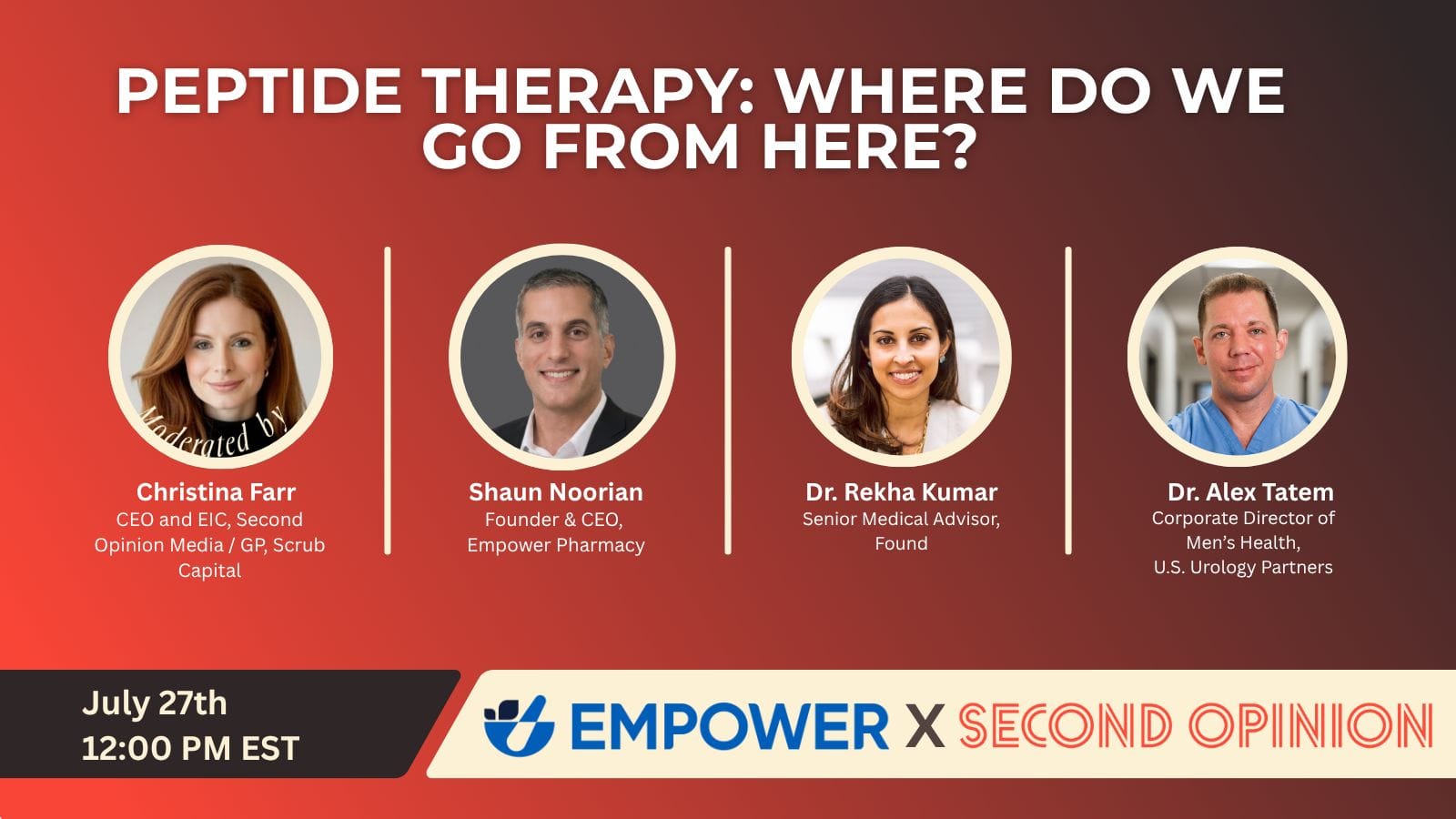
Peptide Therapy: Where Do We Go From Here?
Watch the full webinar Peptide therapies have moved from niche biohacking circles into mainstream medicine, reshaping conversations around weight management, metabolic health,

Not everyone can access the top 1% of physicians. Will AI change that?
Historically, top-tier medical expertise was limited by wealth and geography. As AI reshapes healthcare delivery, a vital question emerges: can it democratize intelligence to give everyone access to the caliber of care typically reserved for the top 1%?

Privacy AI and the Future of HIPAA
Watch the Full Webinar As AI reshapes healthcare and more patient data flows beyond traditional clinical settings, the rules governing privacy, access,

What will AI do for employer healthcare and benefits?
Employer healthcare may be one of the most practical — and overlooked — proving grounds for AI.

Hospitals as the new go-to-market, lessons from the trenches
Watch the Full Webinar Health systems are entering a new frontier, one where innovation isn’t optional, and meaningful change requires creativity,