

OMG! Omada Health just filed its S1.

I’m frantically reading as I just spotted Omada’s S1! Happy Friday, digital health nerds. This would mark Omada as the second major digital health company to file for an IPO this year after Hinge Health.
Some highlights before I follow up with more detail and a takeaway:
— Revenue is strong and growing, particularly in the last couple of years as the company has moved from selling pre-diabetes to pre-diabetes and diabetes to employers and health plans (diabetes has a higher ARPU). Per the S1:
Revenue increased by 38% from $122.8 million to $169.8 million for the years ended December 31, 2023 and 2024, respectively, and by 57% from $35.1 million to $55.0 million for the three months ended March 31, 2024 and 2025, respectively.
— The company is selling well with both health plans and employers, and it has a growing channel partnerships strategy with pharmacy benefits managers. Cigna accounts for a very large chunk of overall revenue.
— A key headwind for Omada? Not seeing as much traction as the company would have expected in Medicare. But a tailwind no one could have seen coming: GLP-1s. A large section of the filing is dedicated to the company’s strategy in GLP-1s, which is really focused on supporting members with lifestyle interventions while they’re taking these expensive medications.
— Omada has lots of programs now, even though it’s best known for diabetes. It offers MSK via an acquisition of Physera back in the day, as well as weight management and hypertension. Employers are increasingly looking to move away from “point solutions” so this is a smart strategy.
— Engagement is good, and customer satisfaction is strong — overall it’s fairly similar to Hinge in this regard. It reports over 55% member retention at one-year mark, with more than 30 interactions per month on average.
— Its losses are $47.1 million net loss in 2024, an accumulated deficit of $444.0 million as of December 31, 2024. That is going to be a flag for public markets investors that are looking for strong metrics around both growth and profitability.
— Gross margin is strong at around 60% and is still continuing to tick up.
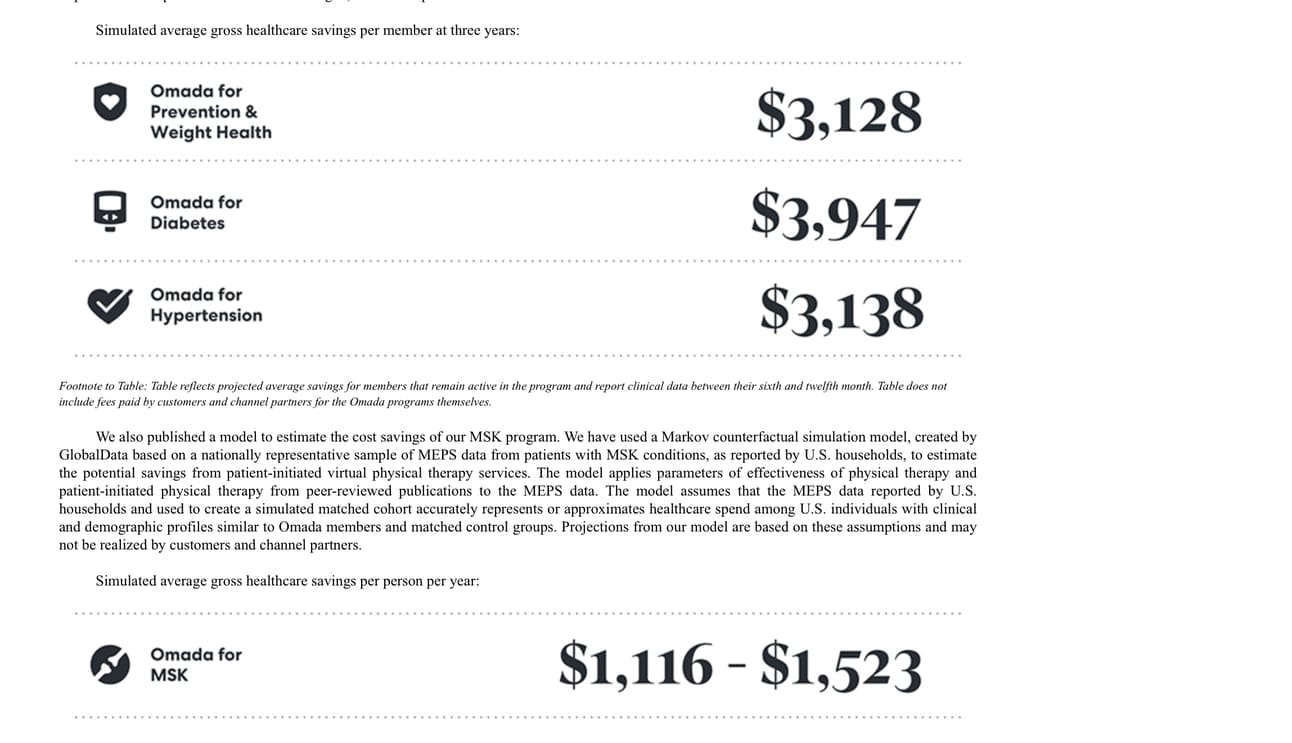
— The company says it is seeing a gross savings for employers after a three-year period in all of these categories. That is critical as the average employee these days tends to stick around with an employer for less than four years - so it’s essential that the value is delivered quickly.
A takeaway?
There’s so much to say here for me personally. Omada is a company that I’ve known for close to 15 years, and truly one of the first in digital health to emerge. It also paved the path for so many other companies in the space through some key realizations. The main one, in my opinion: It is better to be a provider and touch medical spend, and not a vendor, particularly in the context of selling to health plans and employers.
Let’s see how this one does in the public markets. With Hinge and Omada moving swiftly towards exits that our sector so desperately needs, this could mean a lot more enthusiasm in the category overall.
I’ll write a more complete follow up on this topic next week when I get a chance to dig in more.
Upcoming Sessions
Live conversations with the people shaping healthcare.

Verifying AI in Medicine: Is Healthcare AI Actually Ready for Deployment?
Is AI ready for real-world clinical care? Dr. Zak Kohane and Protege’s Engy Ziedan debate what it takes to safely trust AI in diagnosis and treatment, from benchmark performance and clinical evidence to whether we’re holding AI to a higher standard than humans.

Why Are Hospitals Hiring Chief AI Officers?
As AI moves from pilots into day-to-day healthcare operations, health systems are having to decide who should actually own the


Where are AI Agents Actually Working in Healthcare, and Why?
While the healthcare industry remains locked in a high-level debate over the theoretical potential of artificial intelligence, a select group of

Top Employers Share What Healthcare Startups Need to Know in 2026
As enterprise health purchasers face volatile medical cost trends and tightening operational margins, the standard vendor pitch of "improved clinical efficiency&

Peptide Therapy: Where Do We Go From Here?
Watch the full webinar Peptide therapies have moved from niche biohacking circles into mainstream medicine, reshaping conversations around weight management, metabolic health,

Not everyone can access the top 1% of physicians. Will AI change that?
Historically, top-tier medical expertise was limited by wealth and geography. As AI reshapes healthcare delivery, a vital question emerges: can it democratize intelligence to give everyone access to the caliber of care typically reserved for the top 1%?

Privacy AI and the Future of HIPAA
Watch the Full Webinar As AI reshapes healthcare and more patient data flows beyond traditional clinical settings, the rules governing privacy, access,

What will AI do for employer healthcare and benefits?
Employer healthcare may be one of the most practical — and overlooked — proving grounds for AI.

Hospitals as the new go-to-market, lessons from the trenches
Watch the Full Webinar Health systems are entering a new frontier, one where innovation isn’t optional, and meaningful change requires creativity,