

Peptides Regulatory Future Is Taking Shape
Peptides’ alluring anti-aging and longevity benefits have surfaced on every corner of the internet as the drugs have moved from health optimizers and biohacking elites to the mainstream. And the regulatory framework is evolving in lockstep with the demand, opening up a major opportunity for startups and investors.
This week, the FDA’s Pharmacy Compounding Advisory Committee is meeting to review whether a popular category of seven peptides can be legally eligible for compounding, and we’ll be watching closely.
This comes after HHS Secretary Robert F. Kennedy Jr. announced he would reverse a Biden-era call that made it illegal to compound a group of investigational peptides classified as Category 2, including BPC-157, TB-500, and MOTS-C, most commonly used for tissue repair and improving metabolic function. New regulatory pathways could shift access despite safety concerns and a lack of robust clinical research.
We’ll discuss the implications and answer your questions at an upcoming interactive webinar.
Sign up is available for all subscribers below.
Reserve Your Spot for Upcoming Webinars!
Episode 2 of Rounds is here!
Co-hosted by Christina Farr and Stephanie Davis, this episode dives into the biggest debates shaping digital health right now. Keaton Bedell, co-founder and CEO of Bridge, joins to unpack an exclusive data report on where virtual care is headed next, and Joe DeVivo, President, CEO, and Chairman of Butterfly Network, sits down to talk about the Midjourney partnership that's redefining the future of full-body imaging.


Beyond GLP-1s.
Peptides have been arguably the most popular consumer longevity protocol of the last couple of years.
The GLP-1 craze catapulted the peptide boom, and the enticing benefits marketed by a new class of the drugs have gained public attention. This year, a five-course peptide tasting menu was reportedly held in San Francisco, and we expect more like this in the months to come.
Matthew Brown, a principal at Headline, who invests across consumer health and wellness, says his team is “bullish” on the future of peptide therapy as people have become more comfortable with the idea of injecting themselves for health optimization.
Peptides are short chains of amino acids naturally produced in the body that can affect the body’s immune system, digestion, and more. The active peptide in the popular GLP-1 drugs is FDA-approved for weight management. Insulin is also a peptide that helps control blood sugar for those with diabetes. Other peptides, though, have a murkier scientific base due to a lack of robust, human clinical research.
Many of them, popular among athletes, health optimizers, and increasingly, the general public, are enticing for their potential anti-aging properties, from reducing strain and aiding in muscle growth to helping boost sexual function and speed up fat loss. In men’s health circles, they’ve gained traction to improve performance and accelerate recovery.
“Taking a pill or an injection is easier than eating healthy and working out. I think people fully embrace that,” Brown tells Second Opinion. While peptides are top of mind for Brown and his firm, he’s less optimistic about the brands that have “limited defensibility” and “less product differentiation.” He’s most optimistic about the next layer of care, which includes clinical oversight, outcomes tracking, and potentially, an employer-led payment stream and data compliance infrastructure.
“We're trying to figure out if those will be the winners,” Brown says of companies already in the next layer like Midi and Hone Health. “Or, will there be net new companies?”
While Brown bets on where the industry is headed, consumers are facing a complex landscape right now.
Where Patients Are Actually Buying
A recent consumer survey of 500 people found one in seven peptide users have bought them from Telegram, WhatsApp, or social media, with 75% using AI to inquire about dosage. The survey also found that nearly half of those who got their peptides from social media or Telegram have visited the ER, begging the question of how those curious to try a peptide manage the safety risks. As of today, consumers have turned to the unregulated gray market, so it will be important to follow whether regulatory changes will shift sourcing and quality and how companies assess risk.
This spring, the American Medical Association cautioned both patients and physicians to “look past social media claims and marketing promises” given the potential health risks of newer injectable peptides. Dr. Anthony C. Tam, a family and sports medicine physician with Henry Ford Health, told the AMA that unlike insulin and GLP-1s, which have been tested and targeted for a specific disease, newer peptides are not widely studied outside of animal trials and notes that there are not clear guidelines for dosage.
When it comes to regulation, none of this is settled. What's compoundable this week may not be next month, and patients are already making decisions in that gap.
Brown says he’s not taking risks during this regulatory limbo, but is continuing to look at investing in the deeper layers of the peptide ecosystem. “Where does value accrue versus which ones are ‘get rich quick’ schemes?” Brown asks. “What is the balance of the demand of a good business model and the durability and defensibility of their spot in the value chain?”
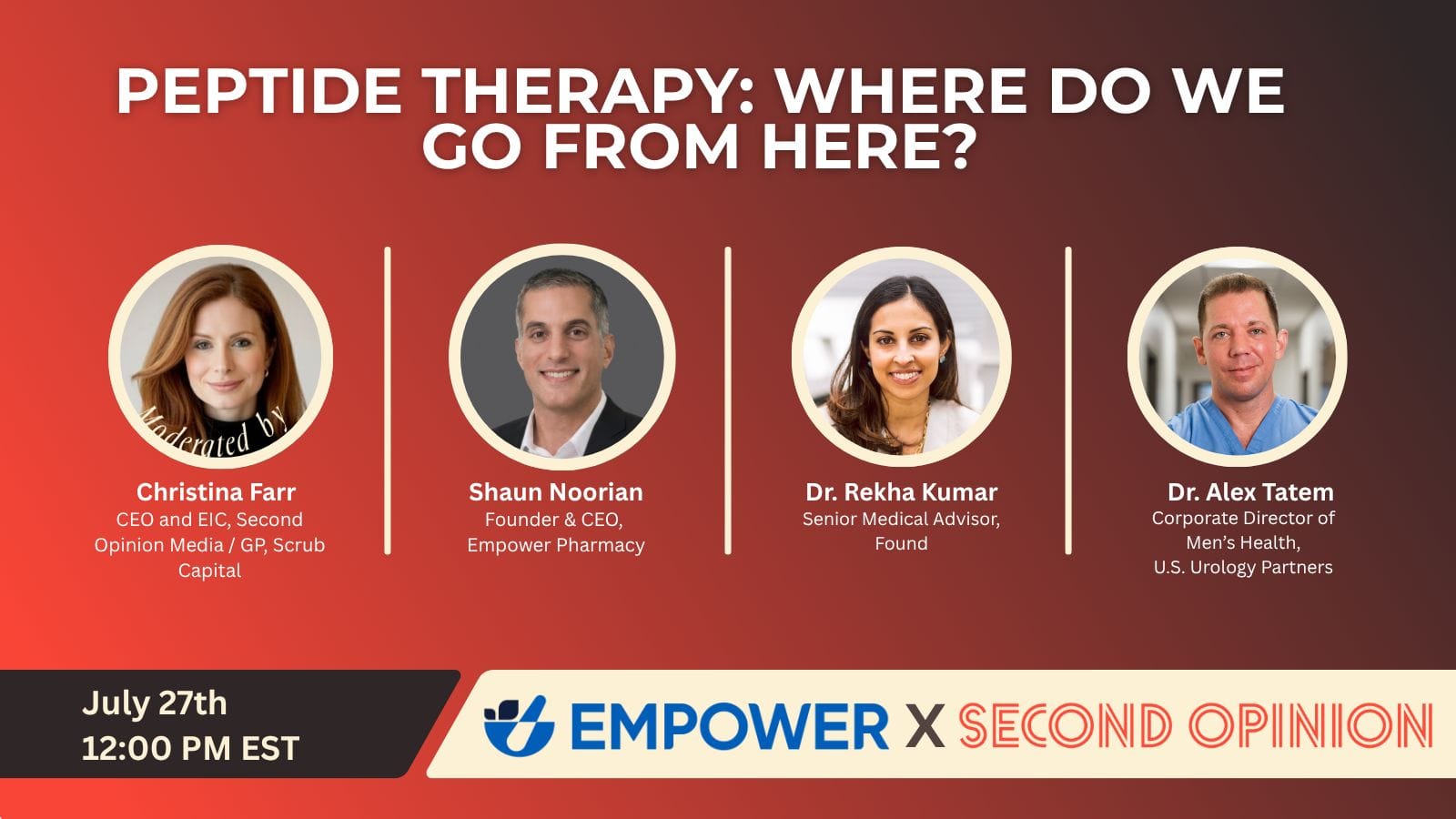
The shifting rulings, emerging clinical claims, and the future of consumer-driven peptide therapy will be unpacked in Second Opinion’s upcoming webinar, “Peptide Therapy: Where Do We Go From Here?” on July 27th. Chrissy will moderate a discussion withShaun Noorian, the CEO of Empower Pharmacy, Dr. Rekha Kumar, the senior medical advisor of Found, and Dr. Alex Tatem, the corporate director of Men’s Health at U.S. Urology.
Register here: Peptide Therapy: Where Do We Go From Here?
Not already a Second Opinion subscriber?Get weekly insights on health‑tech delivered straight to your inbox. Join the mailing list for free Or copy & paste this link into your browser: |
Upcoming Sessions
Live conversations with the people shaping healthcare.

Verifying AI in Medicine: Is Healthcare AI Actually Ready for Deployment?
Is AI ready for real-world clinical care? Dr. Zak Kohane and Protege’s Engy Ziedan debate what it takes to safely trust AI in diagnosis and treatment, from benchmark performance and clinical evidence to whether we’re holding AI to a higher standard than humans.

Why Are Hospitals Hiring Chief AI Officers?
As AI moves from pilots into day-to-day healthcare operations, health systems are having to decide who should actually own the


Where are AI Agents Actually Working in Healthcare, and Why?
While the healthcare industry remains locked in a high-level debate over the theoretical potential of artificial intelligence, a select group of

Top Employers Share What Healthcare Startups Need to Know in 2026
As enterprise health purchasers face volatile medical cost trends and tightening operational margins, the standard vendor pitch of "improved clinical efficiency&

Peptide Therapy: Where Do We Go From Here?
Watch the full webinar Peptide therapies have moved from niche biohacking circles into mainstream medicine, reshaping conversations around weight management, metabolic health,

Not everyone can access the top 1% of physicians. Will AI change that?
Historically, top-tier medical expertise was limited by wealth and geography. As AI reshapes healthcare delivery, a vital question emerges: can it democratize intelligence to give everyone access to the caliber of care typically reserved for the top 1%?

Privacy AI and the Future of HIPAA
Watch the Full Webinar As AI reshapes healthcare and more patient data flows beyond traditional clinical settings, the rules governing privacy, access,

What will AI do for employer healthcare and benefits?
Employer healthcare may be one of the most practical — and overlooked — proving grounds for AI.

Hospitals as the new go-to-market, lessons from the trenches
Watch the Full Webinar Health systems are entering a new frontier, one where innovation isn’t optional, and meaningful change requires creativity,