

A top healthcare VC ponders whether there will be another value-based care home run

Thank you to B Capital’s Adam Seabrook for saying the quiet part out loud. We talk ad nauseam about value-based care at events and conferences, but the fee-for-service payment model continues to dominate. Most of us agree that value-based care is where healthcare should be going in the future, but progress has been slow because it’s easier said than done. It’s my personal view that until we can put pen to paper and explore what is required to invest in value-based care – longer timelines, heavier capital requirements, and so on – then the opportunity won’t get the allocation it deserves. And Adam has done that, while honestly asking the question of whether venture investors can make Power Law returns by investing in value-based care.
As a follow-up to this column, I’ve invited Adam and a panel of experts to join me on a LinkedIn Live to discuss venture capital and value-based care, as well as alternative funding sources. Stay tuned!
By Adam Seabrook

The U.S. health insurance industry has been working on transferring financial risk to providers for at least two decades, even as progress has been slow1. The goal of all of this change is to better align provider incentives with the health outcomes of the patients they serve. If fee-for-service (FFS) entices providers to do as many exams and procedures as possible to maximize revenue, then value-based care (VBC) flips that incentive by encouraging providers to control the cost of care through a share of the profits derived from treating a population of patients efficiently. There’s more to gain than just affordability; there’s the potential to offer higher-quality care, as well as services that are not traditionally billable in a fee-for-service construct.
Analyzing the Trailblazers in VBC
For investors, it sounds like a lucrative opportunity and the proposition has attracted billions of dollars of venture and growth capital. Let’s take a snapshot of the largest companies in the value-based care arena, and the capital they’ve accumulated to date:
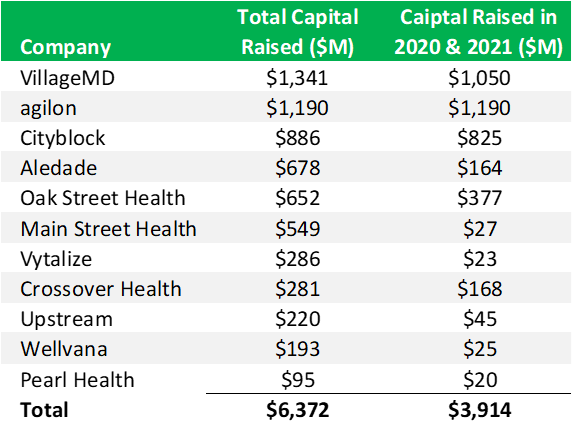
$6.5B is a lot of money and it’s interesting to see that more than 60% of it was raised in 2020 and 2021 when the Fed funds rate was effectively 0%. Capital was certainly more freely available. After all of that investment, it’s worth asking the question about whether or not VBC is a good place to make an early-stage investment. While the opportunity may sound incredibly attractive, and there’s no doubt VBC is moving healthcare in the right direction, it remains a big challenge for investors to see a return on their investment commensurate with the risk they take.
`Upcoming Sessions
Live conversations with the people shaping healthcare.

Verifying AI in Medicine: Is Healthcare AI Actually Ready for Deployment?
Is AI ready for real-world clinical care? Dr. Zak Kohane and Protege’s Engy Ziedan debate what it takes to safely trust AI in diagnosis and treatment, from benchmark performance and clinical evidence to whether we’re holding AI to a higher standard than humans.

Why Are Hospitals Hiring Chief AI Officers?
As AI moves from pilots into day-to-day healthcare operations, health systems are having to decide who should actually own the


Where are AI Agents Actually Working in Healthcare, and Why?
While the healthcare industry remains locked in a high-level debate over the theoretical potential of artificial intelligence, a select group of

Top Employers Share What Healthcare Startups Need to Know in 2026
As enterprise health purchasers face volatile medical cost trends and tightening operational margins, the standard vendor pitch of "improved clinical efficiency&

Peptide Therapy: Where Do We Go From Here?
Watch the full webinar Peptide therapies have moved from niche biohacking circles into mainstream medicine, reshaping conversations around weight management, metabolic health,

Not everyone can access the top 1% of physicians. Will AI change that?
Historically, top-tier medical expertise was limited by wealth and geography. As AI reshapes healthcare delivery, a vital question emerges: can it democratize intelligence to give everyone access to the caliber of care typically reserved for the top 1%?

Privacy AI and the Future of HIPAA
Watch the Full Webinar As AI reshapes healthcare and more patient data flows beyond traditional clinical settings, the rules governing privacy, access,

What will AI do for employer healthcare and benefits?
Employer healthcare may be one of the most practical — and overlooked — proving grounds for AI.

Hospitals as the new go-to-market, lessons from the trenches
Watch the Full Webinar Health systems are entering a new frontier, one where innovation isn’t optional, and meaningful change requires creativity,