

Tech-Enabled Healthcare Services Will Be the Winners of the AI Era
Alyssa Jaffee is a Partner at 7wire Ventures, a venture capital firm focused on digital health companies that empower individuals to take an active role in managing their health.
In 2022, we published an original piece in defense of tech-enabled services, arguing that it will persist as the dominant business model in digital health. Now that we are fully in the AI era of healthcare – with use cases present across all facets of the industry, and with startups and venture capitalists alike trying to build enduring companies amidst the excitement – I continue to hold this belief, and will be doubling down. In fact, I foresee our original predictions, including tight bundling of software with services to enhance adoption, pushes to address the totality of a patient’s needs, and increases in margins and LTVs, accelerating in the face of AI enablement.
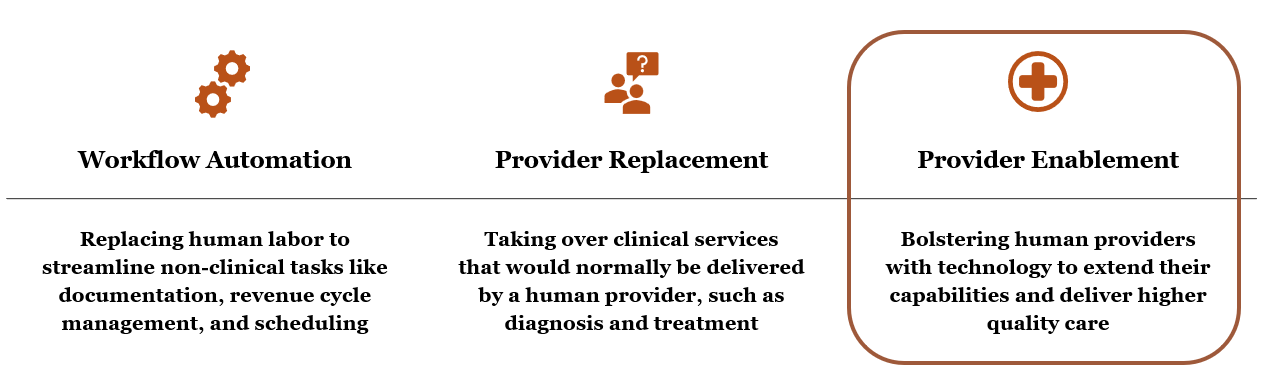
In health AI, we see a few primary strategies at work.
Workflow automation and provider replacement startups are building AI tools with an eye to selling them into health systems, payers, and life sciences organizations. Provider enablement or tech-enabled services startups already own the care delivery, and they will be using AI to make their own providers more efficient. VCs are already investing and will continue to invest more into the first bucket of tools. I will be investing in the latter, as I believe these companies continue to be positioned to win in the long run.
Allow me to make the argument. I’ll acknowledge here that I do have a bias in that my fund, 7wire Ventures, invests heavily in tech-enabled services (and openly acknowledges that this is our focus). But that very same bias gives me a first-hand perspective. I have seen many of these companies adapt to an AI era as they scale and find new efficiencies, so I’ll pepper in those anecdotes and case studies throughout.
Reserve Your Spot for Upcoming Webinars!
AI-native tech-enabled services companies will experience major lifts from the perspective of their unit economics. As these startups lean into more AI use – for example, scribes to reduce the time spent writing notes, AI-generated treatment plans, or patient engagement tools that help draft personalized messages to each member – they will be able to reach very different margin profiles. NOCD, which is a platform for complex psychiatric conditions where I sit on the board, has been able to use its internal AI platform to save their therapists two to twelve hours each week on administrative tasks like scheduling and drafting notes. In a 40-hour work week, this is extremely valuable. Not only does this free up time that therapists can instead spend in clinical sessions by upwards of five additional hours each week, but it focuses therapist time where it matters most. As a result, NOCD has seen improved per-therapist revenue, driving a more favorable economic profile. This is particularly important given the finite pool of providers.
There’s also a big opportunity here to transform care without waiting for a three-year sales cycle and implementation process. It’s my view that tech-enabled services businesses will be able to drive better clinical outcomes and, therefore, push payers to secure more favorable rates over time. One company we know used AI to create a “digital twin” of both the provider and the patient, which was then integrated into its clinical training process. This approach significantly reduced the cost of training while, more importantly, helping providers deliver higher-quality care and achieve better outcomes. With stronger outcome data in hand, the company was able to go back to payers and more than double its reimbursement rates. In practice, this translated into a dramatic increase in revenue per visit with top-line increases of over 200%.
Another area where the financials will meaningfully improve is operating expenses, as fewer team members will be hired at scale. Companies that are able to achieve greater care team productivity will reduce the direct cost of delivering this care. Tech-enabled services businesses will always need a supply of providers, but making those providers and care team members more efficient can create a meaningful lift on margin and cash burn. For instance, Transcarent – another one of my portfolio companies – helps employees navigate and access their care benefits, and the company has been leaning on AI to improve the member experience and reduce the burden that historically fell to care team members. As a result of their WayFinding AI platform, 83% of member questions are resolved without needing human intervention, allowing the Care Support team to prioritize their time on more complex needs. In addition, AI is driving improvements in care team capacity – with AI, preparing for a second medical opinion now takes eight to twelve minutes instead of the eight to twelve hours it used to take, allowing providers to see more members.
`Upcoming Sessions
Live conversations with the people shaping healthcare.

Verifying AI in Medicine: Is Healthcare AI Actually Ready for Deployment?
Is AI ready for real-world clinical care? Dr. Zak Kohane and Protege’s Engy Ziedan debate what it takes to safely trust AI in diagnosis and treatment, from benchmark performance and clinical evidence to whether we’re holding AI to a higher standard than humans.

Why Are Hospitals Hiring Chief AI Officers?
As AI moves from pilots into day-to-day healthcare operations, health systems are having to decide who should actually own the


Where are AI Agents Actually Working in Healthcare, and Why?
While the healthcare industry remains locked in a high-level debate over the theoretical potential of artificial intelligence, a select group of

Top Employers Share What Healthcare Startups Need to Know in 2026
As enterprise health purchasers face volatile medical cost trends and tightening operational margins, the standard vendor pitch of "improved clinical efficiency&

Peptide Therapy: Where Do We Go From Here?
Watch the full webinar Peptide therapies have moved from niche biohacking circles into mainstream medicine, reshaping conversations around weight management, metabolic health,

Not everyone can access the top 1% of physicians. Will AI change that?
Historically, top-tier medical expertise was limited by wealth and geography. As AI reshapes healthcare delivery, a vital question emerges: can it democratize intelligence to give everyone access to the caliber of care typically reserved for the top 1%?

Privacy AI and the Future of HIPAA
Watch the Full Webinar As AI reshapes healthcare and more patient data flows beyond traditional clinical settings, the rules governing privacy, access,

What will AI do for employer healthcare and benefits?
Employer healthcare may be one of the most practical — and overlooked — proving grounds for AI.

Hospitals as the new go-to-market, lessons from the trenches
Watch the Full Webinar Health systems are entering a new frontier, one where innovation isn’t optional, and meaningful change requires creativity,