

The food industry considers GLP-1s

Ruth’s reporter’s notebook: This week, I was down in Washington, D.C. for the 2026 Food Is Medicine Conference, where lawmakers, health systems, clinicians, and researchers converged to discuss how healthy food can be better incorporated into medical treatment and what policies can support that.
More clinicians, policy experts, and patients are embracing the idea that food should be more integrated into patient care. There is also a growing support for policies that limit the production of ultraprocessed foods, which have been shown to negatively impact human health.
The big takeaway: Federal and state policies may conflict with broader efforts to make healthy food a component of patient care.
Americans have a growing awareness about ultra processed foods. More than half of Americans have heard about ultra-processed foods, according to a February survey from the American Journal of Public Health, but fewer are confident about what they are.
AJPH has published several pieces of research this year highlighting the harms of consuming ultraprocessed foods, including:
● Increased risk of diabetes, cancer, obesity, and all-cause mortality.
● Higher body mass index, blood sugar, and blood pressure
● Greater risk of cognitive impairment and dementia in older adults
The discussion around ultraprocessed foods, prompted in part by the Make America Healthy Again movement, comes as a growing number of states are putting restrictions on Supplemental Nutrition Assistance Programs, so that recipients can’t use government funding for sodas and ultra-processed foods. However, some states that have adopted nutrition-focused restrictions on SNAP are not providing other ways for impoverished Americans to afford healthy food. Missouri, for example, has embraced SNAP restrictions, but is reducing funds that help lower-income residents afford fresh produce.
At the federal level, both Democrats and Republicans are enthusiastic about testing insurance coverage of nutrition plans prescribed by doctors. At FIMCON, Sens. Roger Marshall (R-Kans.) and Jim McGovern (D-Mass.), and Rep. Chellie Pingree (D-Maine) all expressed support for a bill that would pilot home-delivered medically tailored meals for Medicare patients.
Medically tailored meals have been shown to improve health outcomes for patients and reduce costs and more health systems are embracing them. Some health systems, like Geisinger in Pennsylvania, have gone farther, building food pharmacies where patients can pick up food for diets tailored by their doctor.
But food as medicine needs more research, funding, and a deeper understanding of why patients fall-off these programs.
Interesting market dynamic: The rise of GLP-1s is apparently causing food manufacturers to rethink their commercial food strategies: “If your model is based on impulse and indulgence, you really need to review it,” said Maha Tahiri, a food consultant who has held leadership roles at General Mills, Danone and Coca-Cola.
Food companies are considering how they can be supportive of GLP-1 users with news food products that are healthier. Ag Funder News points writes that increasingly, they’re thinking about consumers as patients—- a slightly different bangle on the food as medicine trend.
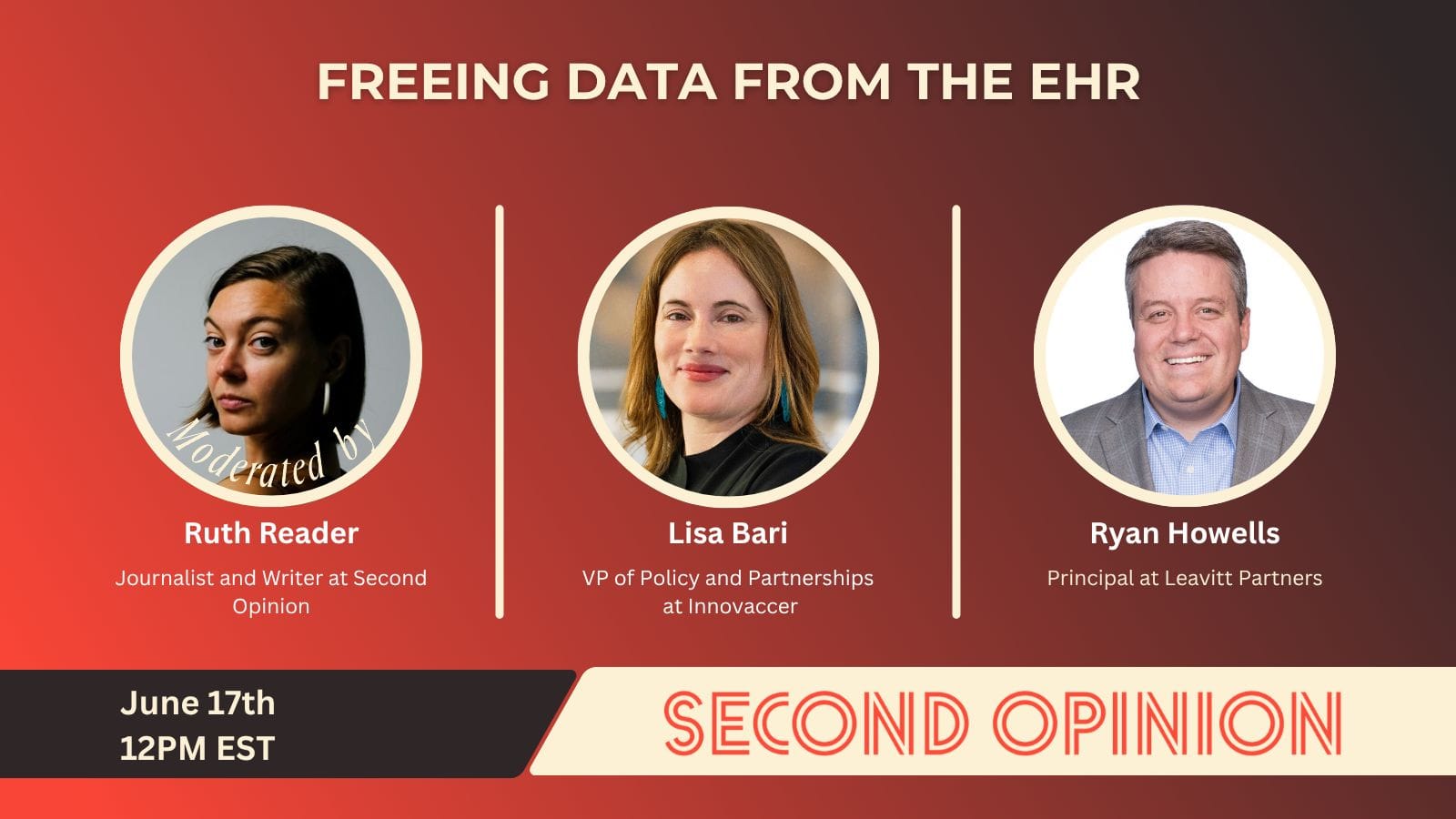
Reserve Your Spot for Upcoming Webinars!
NEWS
Amazon's Health AI Bot Exposes a Flaw in Patient Data Access
Amazon’s AI health bot is raising questions about the ethics and security of having a bot pull medical records from existing health data exchanges, Ruth reports.
Members of Carequality, a framework that health institutions use to access patient medical records, are debating whether a bot should be able to access patient data as someone involved in the treatment of a patient, according to two people familiar with the matter.
Sen. Bernie Sanders wants you to get paid for AI
This week, Senator Bernie Sanders (I-Vt.) introduced legislation
The American A.I. Sovereign Wealth Fund Act would “give the public a direct ownership stake in the largest A.I. companies in our country.” The bill creates a sovereign wealth fund through a one-time 50 percent tax on AI company stocks. This would give the government voting shares and the ability to block decisions that could negatively impact public welfare, he wrote inaNew York Timesop-ed.
Patients can bring AI to the doctor’s office, too
AI scribes have become the norm during doctor visits, with about a quarter of physicians using them to document visits. But apps are now targeting a new, related market: patients. A number of companies such as Kin Health, which announced a $9 million seed round in May, are convincing patients of the benefits of recording and documenting their visits, too.
New Medicaid rule may cut off millions of sick patients
A new rule from the Trump administration could prevent millions of people with serious conditions, such as HIV/AIDS or cancer, from accessing Medicaid or maintaining coverage if they cannot comply with the work requirements. “Congress promised that no cancer patients would lose their coverage under the One Big Beautiful Bill,” Dr. Gwen Nichols, the chief medical officer at Blood Cancer United, told The New York Times. “This rule undercuts that promise.”
States are also grappling with the high cost of upgrading the tech systems that manage Medicaid enrollment in order to implement the work requirements.
About half of Americans own a wearable
According to a survey by Rock Health, 57% of adults in the US own at least one wearable or connected health tracking device. The percentage of Americans owning a wearable is 46% — it was 13% in 2015. But growth has been stagnant, as new user acquisition has reached a plateau in recent years.
Google tests a passive heart rate monitor for phones
This week, Google showed off the potential of using smartphones to monitor heart health. The company debuted adeep-learning based passive heart-rate monitoring system that uses facial video-based photoplethysmography to detect both heart rate and resting hear rate, during everyday interactions on a smartphone, the company’s researchers shared in astudy published inNature.
INTELLIGENCE
Da Pope’s encyclical on AI has been unexpectedly insightful in the age of AI-enabled health care. In her newsletter, STAT’s Brittany Trang read the missive, parsing what it means for Catholic hospitals — and health providers more broadly. One paragraph in particular seems worth taking in:
103. Indeed, entrusting an algorithm in practice with the power to select who is worthy or not, without anyone bearing responsibility for that judgment, is to hand over the task of redefining the boundaries of human possibilities. In this process, political responsibility is also lost, not just empathy toward those excluded, which can, after all, be simulated. The exclusion of the vulnerable becomes cloaked in a veneer of neutrality and objectivity, against which it becomes difficult to raise objections. In this way, injustice goes unnoticed, and compassion, mercy and forgiveness — understood not as mere appearances but as real political actions — gradually disappear from view.
DEALS & ACQUISITIONS & LAUNCHES
AI radiology imaging company Subtle Medical closed a $33 million Series C round led by Morgan Stanley Expansion Capital.
Adaptive, an AI-native home health provider, raised $50 million in Series A funding from Felicis and Bain Capital Ventures.
Novellia, a patient-powered data platform, secured $18 million in a Series A round led by Spark Capital. The latest investment brings the company’s total funding to $28 million.
Male contraceptive drug developer Contraline announced $92.5 million in Series B financing for the late-stage development of NES/T, a hormonal contraceptive gel. The round was co-ledby BVF Partners L.P. and RA Capital Management. The product, which could be first-in-class, will enter a Phase 3 trial in 2027.
Signos raised$20 millionfor its weight management system based on continuous glucose monitoring, the first to receive FDA clearance. The funding was raised from GV (Google Ventures), Dexcom, and Blue Cross Blue Shield of Alabama.
Ilant Healthraised$15 millionin a Series A led by Cornucopian Capital to expand its value-based obesity care. The company’s total funding to date is $22 million.
Century Health secured $5 million in seed funding for its AI platform dedicated to accuracy in clinical data abstraction.
Primary care platform Elation Health acquired Aster, an AI-native electronic health record company focused on women's health. The acquisition — whose financial terms have not been disclosed — is part of its development of agentic operating capabilities for primary care.
Mayo Clinic is working with Microsoft to develop and deploy a frontier AI model designed for healthcare. According to the organizations, the model will be "capable of supporting the broadest scope of clinical reasoning and healthcare use cases.”
Weight loss company Noom is offering an at-home biomarker testing kit to expand its platform into diagnostics and metabolic health monitoring.
Teladoc services will be available to Walmart Better Care users for a cash price of $89 per visit.
Lifers this week!
This week on Lifers, host Christina Farr delves into the contrast between AI and SaaS with Guillaume de Zwirek, CEO of Artera, and Dan Goldsmith, Artea board member and co-founder & partner at Proofpoint Capital. In the episodes they talk about how AI offers bespoke solutions delivered at the speed and cost of software, and why the companies that fail to grasp this distinction are already quietly dying.
4 Questions with Kristie Spencer

Second Opinion: Elevance Health has said value-based care needs to be an operating model, not just a contracting strategy. What capabilities matter most to making that work, and where are you seeing the strongest results?
Kristie Spencer: Value-based care works best when it moves beyond the contract and becomes part of the daily decisions care teams make with and for their patients.
The strongest models are built around three things: aligned incentives, actionable insights, and practical support for providers. Incentives help create shared accountability for quality, cost, and patient experience. But incentives alone are not enough. Providers also need timely data, transparent performance reporting, and workflows that help identify opportunities for earlier intervention, prevention, and chronic condition management.
Partnership is what makes that work. If value-based care creates additional administrative complexity for providers, it becomes harder to scale successfully. The goal is to reduce friction, improve data sharing, and give providers tools they can use within the flow of care. When providers have a clearer view of performance and patient needs, they can act with more confidence.
In my experience working with provider organizations, value-based care scales more effectively when it helps clinicians deliver care more efficiently rather than asking them to manage another disconnected program.
The most meaningful progress is happening where health plans and providers are operating from shared goals, shared data, and shared accountability. Shared-risk models can be especially effective because they align both sides around better outcomes and lower costs. At the same time, every provider organization is different, so the model must be flexible enough to meet providers where they are.
Value-based care should not operate as a separate initiative. It should be embedded into how health plans and providers work together every day, supported by shared data, aligned incentives, and practical tools that help deliver more coordinated, lower cost, and higher-quality care. The most effective value-based models take a whole-health approach that connects physical, behavioral, pharmacy, and social factors that influence outcomes and costs.
Second Opinion: You’ve spoken about the role of aligned incentives and actionable insights in driving better outcomes. From your perspective, which levers are proving most effective in sustainably lowering the cost of care, and how do those changes have a measurable impact at the provider and patient level?
Kristie Spencer: Lowering the cost of care sustainably is not about reducing care. It is about helping people access the right care earlier, in the right setting, with the right support. One of the biggest opportunities is identifying needs earlier before they become more acute, more complex, and more expensive to treat.
The most effective levers are those that address avoidable costs at the source. That includes reducing unwarranted variation in care, identifying gaps earlier, improving chronic condition management, and helping patients connect with high-quality providers before needs become more acute or costly.
Aligned incentives matter because they connect financial models to better outcomes, but their impact depends on whether providers act on them with the right data and tools. When providers have a clearer view of patient needs, quality measures, and practice-level opportunities, they are better positioned to improve outcomes while managing cost at the same time.
For providers, that can mean less administrative friction, clearer insights, and stronger support for delivering evidence-based care. For patients, it can mean fewer unnecessary steps, more coordinated care, earlier support, and clearer guidance toward high-quality, cost-effective options.
The strongest models do not treat affordability and quality as competing priorities. They are designed to improve both simultaneously.
Second Opinion: Despite more tools and resources, some consumers still struggle for navigate care decisions. What’s the best way for payers to embed guidance for high-quality, cost-effective care into the care experience?
Kristie Spencer: One of the biggest challenges in healthcare is that information alone does not always enable people to make confident decisions.
Members may have access to provider directories, cost estimates, benefits information, and digital tools, but still be left asking: What should I do next? The opportunity is to connect those pieces in a way that makes the next steps easier to understand and easier to act on.
That means bringing together information about benefits, provider performance, care needs, and available support, so members are not left to navigate the system on their own. Guidance should not exist outside the care experience. It should appear at the moments when decisions are being made, whether someone is selecting a provider, scheduling care, managing a condition, or following up after a visit.
Provider partnerships are a key part of that. When health plans and providers are working from shared data and shared goals, members can be guided to care that is more coordinated, more connected to quality outcomes, and less costly.
Digital tools can help make that experience more personalized and timelier. Platforms like FindCare and the Sydney Health app, combined with proactive care management outreach, can help connect people to high-performing providers and the right next step in their care journey. But technology should make the experience simpler, not add complexity.
The goal is to make the next step feel clear and actionable, even when the healthcare system behind it is complex. Consumers do not want to navigate healthcare alone. They want trusted guidance that is personalized, timely, and connected to their broader care journey.
Second Opinion: What distinguishes healthcare navigation models that are truly integrated into care delivery from those that remain episodic, and how does that difference show up?
Kristie Spencer: The difference comes down to whether navigation is connected to the full care experience or focused on a single point in time.
Episodic navigation can help answer a specific question, but it often lacks the broader context of a person’s health history, benefits, providers, and care journey. That can create fragmentation as people move across providers, care settings, and follow-up needs.
That matters because people do not experience healthcare as one single decision. They may be choosing a doctor, trying to understand what is covered, managing a condition, scheduling follow-up care, or figuring out what to do next. When those steps are disconnected, the experience can feel harder than it should.
I’ve seen this most clearly in provider workflows. When information is disconnected, even well-intentioned solutions can create additional steps for care teams and more confusion for members.
When the right information is connected at the right time, it becomes easier for providers to support the person they are caring for and easier for members to understand what to do next.
Integrated navigation connects health information, benefits, provider quality, and care support so people receive guidance that reflects their broader needs, not just a single transaction or moment of care. It also must work for providers. If navigation does not fit naturally into existing provider workflows, it can create an additional burden instead of improving the experience.
When navigation is connected, members are more likely to get the right care earlier, avoid unnecessary services, and stay engaged in their health. Providers benefit from clearer information, stronger alignment, and fewer administrative barriers.
Over time, that can make the healthcare experience feel less fragmented. Navigation becomes less about directing people and more about helping them move through care with greater clarity, confidence, and support.
Ultimately, value-based care succeeds when it becomes simpler for providers to deliver high-quality care and easier for consumers to navigate their health journey.
Kristie Spencer is Vice President of Provider Partnerships at Elevance Health, where she leads enterprise strategy to optimize value-based care arrangements and strengthen provider partnerships. She is responsible for advancing initiatives that simplify and scale value-based care, improve provider enablement, and drive measurable improvements in quality, lowering the cost of care, and patient experience. Spencer brings more than two decades of leadership experience across health plans, provider organizations, and healthcare services companies.
Upcoming Sessions
Live conversations with the people shaping healthcare.

Verifying AI in Medicine: Is Healthcare AI Actually Ready for Deployment?
Is AI ready for real-world clinical care? Dr. Zak Kohane and Protege’s Engy Ziedan debate what it takes to safely trust AI in diagnosis and treatment, from benchmark performance and clinical evidence to whether we’re holding AI to a higher standard than humans.

Why Are Hospitals Hiring Chief AI Officers?
As AI moves from pilots into day-to-day healthcare operations, health systems are having to decide who should actually own the


Where are AI Agents Actually Working in Healthcare, and Why?
While the healthcare industry remains locked in a high-level debate over the theoretical potential of artificial intelligence, a select group of

Top Employers Share What Healthcare Startups Need to Know in 2026
As enterprise health purchasers face volatile medical cost trends and tightening operational margins, the standard vendor pitch of "improved clinical efficiency&

Peptide Therapy: Where Do We Go From Here?
Watch the full webinar Peptide therapies have moved from niche biohacking circles into mainstream medicine, reshaping conversations around weight management, metabolic health,

Not everyone can access the top 1% of physicians. Will AI change that?
Historically, top-tier medical expertise was limited by wealth and geography. As AI reshapes healthcare delivery, a vital question emerges: can it democratize intelligence to give everyone access to the caliber of care typically reserved for the top 1%?

Privacy AI and the Future of HIPAA
Watch the Full Webinar As AI reshapes healthcare and more patient data flows beyond traditional clinical settings, the rules governing privacy, access,

What will AI do for employer healthcare and benefits?
Employer healthcare may be one of the most practical — and overlooked — proving grounds for AI.

Hospitals as the new go-to-market, lessons from the trenches
Watch the Full Webinar Health systems are entering a new frontier, one where innovation isn’t optional, and meaningful change requires creativity,