

What Growth Equity Investors Look for in Digital Health

In many regards, 2025 was the year of megarounds ($100M+ raises) in digital health. As Rock Health reported, 42%, nearly half, of the 14.2 billion dollars of venture funding raised in 2025 went to megarounds–the highest proportion since 2021. Building a venture-backed digital healthcare company has always been challenging–but in an increasingly bifurcated investing environment, where fewer companies are capturing larger checks, understanding what mid-stage to late-stage growth investors are looking for has never been more important for founders (and joiners who want to work at companies that will last) to understand. At the same time, we have found a gap in coverage of growth equity investors in digital health. Maybe this is because “growth equity” itself can be a bit opaque.
In truth, growth equity is not so much a specific funding round or size so much as a company’s stage in its growth trajectory; growth equity investors operate very much on a spectrum. Growth checks can be as small as $20M up to over $100M-$150M. In digital health in particular, as exit opportunities in public markets have been mixed, growth equity investors have increasingly included a broader spectrum of investing, like cross-over or pre-IPO investing rounds. In a broad sense, growth equity investors can take majority or minority positions, and investment strategies can resemble early-stage venture investing or more traditional PE (i.e., middle-market buyout strategies)
One thing is certain: growth equity investors are looking for companies that can scale. In digital health, this generally means proven, measurable outcomes and sustainable unit economics; companies that are post product-market-fit and are using capital to accelerate distribution.
We surveyed investors from 10 leading growth equity funds in digital health to see what they look for in companies and in founders so that companies being built today have visibility in what will be asked of them tomorrow. For our purposes, we pursued a more narrow definition of growth equity. We screened for investors who could write a minimum $20 million check and who provide growth capital as opposed to a more traditional PE/buyout strategy.
We are very grateful to the investment teams who participated and shared their thoughts. If you are a digital health founder, are there other questions you wish you could have answered? If you are an investor, what are we missing? Feel free to reach out and to start the conversation.
We ordered the list alphabetically in terms of stage–from those who are “pure-play” growth equity investors to those that invest in both early- and later-stage rounds.

|
17 · SEP · 1:00PM ET Top Employers Share What Healthcare Startups Need to Know in 2026Top employers reveal how healthcare startups can win enterprise buyers, with Nilay Shah sharing procurement priorities, purchasing decisions, outreach strategies, and ROI expectations.
|
|
|
24 · SEP · 12:00PM ET Healthcare AI Has an ROI ProblemJoin Aaron Miri, DHA, FCHIME, CHCIO, EVP and Chief Digital & Information Officer at Baptist Health, to explore how health systems evaluate AI ROI, overcome data bottlenecks, and scale emerging technology into clinical production.
|
|
|
13 · OCT · 12:30PM ET Verifying AI in Medicine: Is Healthcare AI Actually Ready for Deployment?Is AI ready for real-world clinical care? Dr. Zak Kohane and Protege’s Engy Ziedan debate what it takes to safely trust AI in diagnosis and treatment, from benchmark performance and clinical evidence to whether we’re holding AI to a higher standard than humans.
|
|
To read our investor survey, become a premium subscriber today.
`Upcoming Sessions
Live conversations with the people shaping healthcare.

Is It Finally the Moment for Alternative Plan Design?
Employers are under growing pressure to control healthcare costs while improving access, outcomes, and the member experience. That has renewed interest in

Type 2 Diabetes & Cardiometabolic Care: Wearables, AI & GLP-1s
The rise of wearables, GLP-1s, and AI is reshaping treatment for Type 2 diabetes, weight loss, and metabolic disease. We have

Verifying AI in Medicine: Is Healthcare AI Actually Ready for Deployment?
Is AI ready for real-world clinical care? Dr. Zak Kohane and Protege’s Engy Ziedan debate what it takes to safely trust AI in diagnosis and treatment, from benchmark performance and clinical evidence to whether we’re holding AI to a higher standard than humans.

Why Are Hospitals Hiring Chief AI Officers?
As AI moves from pilots into day-to-day healthcare operations, health systems are having to decide who should actually own the


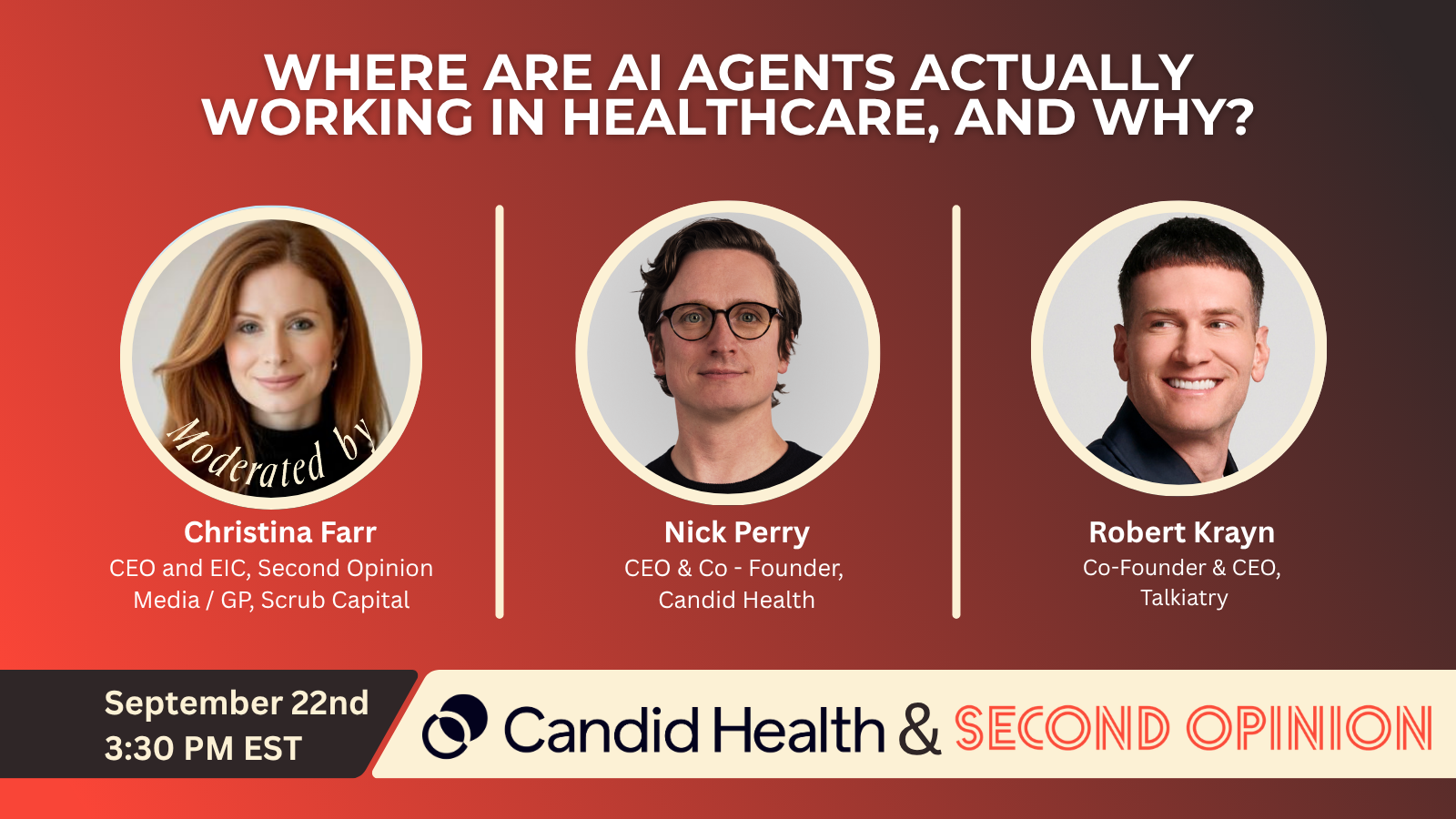
Where are AI Agents Actually Working in Healthcare, and Why?
While the healthcare industry remains locked in a high-level debate over the theoretical potential of artificial intelligence, a select group of

Top Employers Share What Healthcare Startups Need to Know in 2026
As enterprise health purchasers face volatile medical cost trends and tightening operational margins, the standard vendor pitch of "improved clinical efficiency&

Peptide Therapy: Where Do We Go From Here?
Watch the full webinar Peptide therapies have moved from niche biohacking circles into mainstream medicine, reshaping conversations around weight management, metabolic health,

Not everyone can access the top 1% of physicians. Will AI change that?
Historically, top-tier medical expertise was limited by wealth and geography. As AI reshapes healthcare delivery, a vital question emerges: can it democratize intelligence to give everyone access to the caliber of care typically reserved for the top 1%?

Privacy AI and the Future of HIPAA
Watch the Full Webinar As AI reshapes healthcare and more patient data flows beyond traditional clinical settings, the rules governing privacy, access,