

Why CFOs are freaking out about healthcare costs in 2026
A new survey from the benefits consulting firm Mercer suggests healthcare costs are no longer viewed primarily as an HR or people issue. As these costs have continued to go up year after year, they are increasingly being treated as a core business risk.
The report, titled The CFO Perspective on Health 2026, published in February of this year. The team surveyed 161 finance leaders overseeing healthcare budgets. The findings paint a picture of executives growing increasingly alarmed by the trajectory of employer healthcare spending. Quietly in the background, we are hearing reports of employers starting to cut benefits, including paid family leave.
A few findings that stood out to us:
- A third of CFOs now rank healthcare costs as a top-three operating expense concern, up sharply from 19% in 2024.
- Health benefit cost growth will hit a 15-year high this year. In 2023, cost growth averaged about 3% annually. Before making changes, employers this year face a cost increase of 9%.
- Only about one in four companies said they were able to absorb recent healthcare cost increases without broader business consequences. Others reported slower wage growth, reduced hiring, lower investment, and cuts to other benefits.
- Smaller employers with sub 500 employees are particularly alarmed.
- More than half of CFOs said they are not confident that long-term healthcare management strategies requiring investment are actually saving money.
That last point feels particularly notable, given how much we’ve covered so-called “point solution fatigue” at Second Opinion. Employers for years have layered on navigation companies, condition management programs, and digital health vendors, often with the promise of downstream savings. But finance leaders increasingly appear to be asking a harder question: where is the ROI? Companies that have not sufficiently demonstrated ROI will be in a very tough position moving into 2027, particularly as many of these companies were implemented more than a decade ago. So by now, the results (or lack thereof) should be clear.
This situation is unlikely to improve anytime soon, experts say.
Reserve Your Spot for Upcoming Webinars!
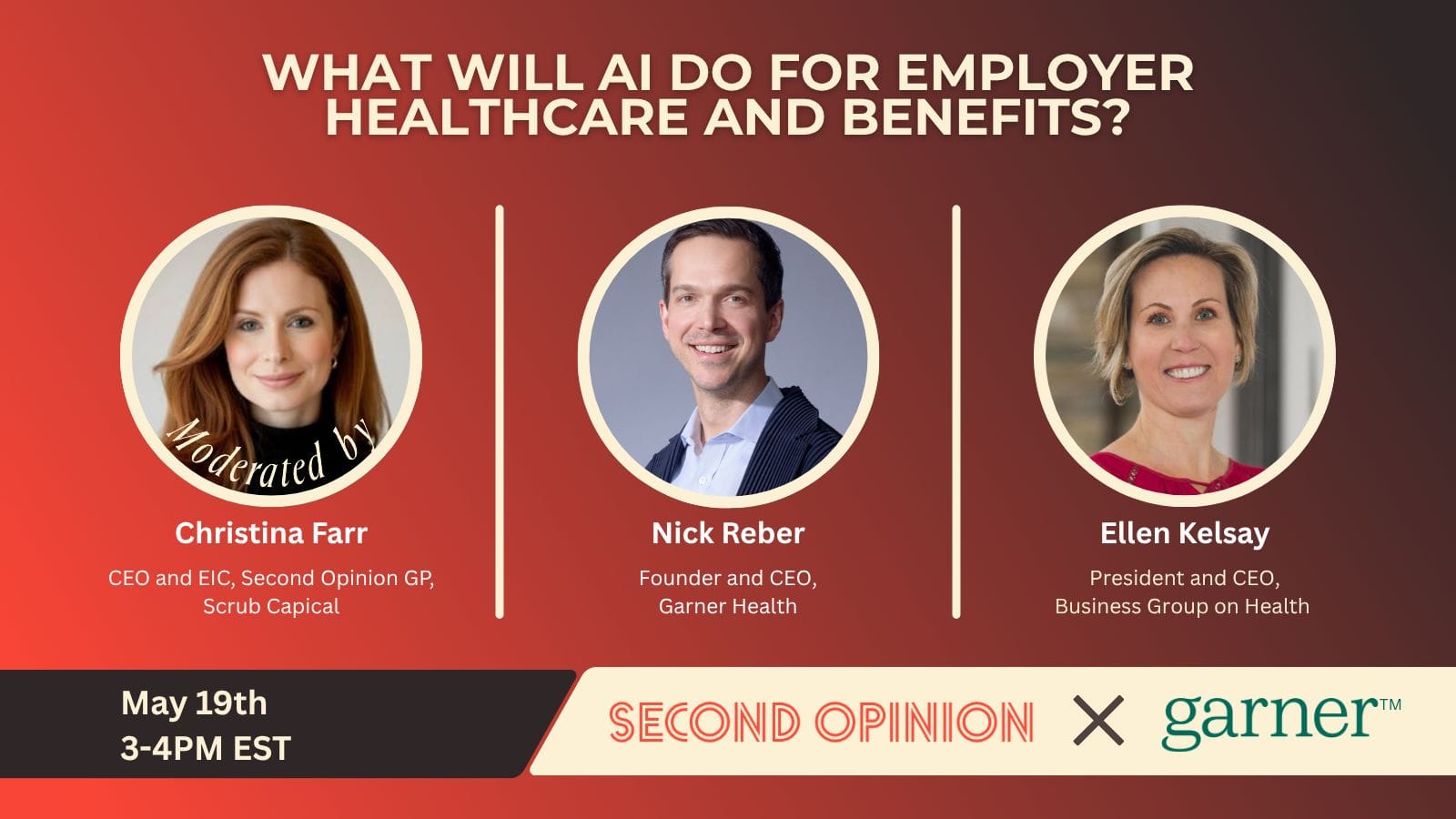
“I’ve been foreshadowing that costs will get worse,” said Ellen Kelsay, President and CEO of Business Group on Health, an organization that works closely with employers to tackle healthcare costs. Kelsay pointed to compression in federal spending on Medicare and exchanges as resulting in a cost shifting to the commercial market, inflationary AI trends, overall decline in population health, GLP-1s, and cell and gene therapies as all being factors for increasing costs.
“Savvy HR/Benefits leaders must embrace this moment of reckoning proactively,” she said.
The survey also highlighted growing concern around:
- GLP-1 spending
- Expensive cancer and rare disease therapies
- Hospital consolidation and associated spend
- Worsening claims volatility
- The broader unpredictability of healthcare expense forecasting.
One interesting nuance: CFOs don’t seem solely focused on cost shifting.
Yes, many still support higher deductibles and employee contributions. But there was also strong support for curated provider networks and more aggressive strategies to manage clinical care, including optimization around the physician and the site of care. The industry is considering alternative health plan models that were previously thought to be infeasible.
That suggests employers may increasingly prioritize: measurable outcomes, tighter management of high-cost care, and financial predictability over simply reducing utilization.
Among self-funded employers:
- 77% said healthcare costs are less predictable than other business expenses
- Half said they’ve been warned by the benefits department to expect even more claims volatility going forward.
That matters because CFOs care deeply about forecasting and getting ahead of potential surprises. CFOs can manage high costs when they know ahead of time that they’re coming.
Kelsay said that benefits leaders should consider one or all of the above as they think through how to manage rising healthcare costs:
- Go back to basics – prevention and primary care, healthy lifestyles and building accountability around that, annual screenings, vaccines as appropriate, and proactive management of chronic conditions.
- Drive toward quality and value – stop paying for care that is broken, and point people toward COEs, high-performance networks, advanced primary care
- Embrace alternative models and contracting – health plans, PBMs, direct contracting, direct to employer models, and even direct-to-consumer, where it fits within the strategy.
- Increase vendor accountability for outcomes, remove underperforming vendors, and improve data transparency and data sharing.
- Leverage participant engagement – people are using wearables, AI, direct-to-consumer features for wellbeing, so lean into that and build on that.
- Make the tough calls – leverage leadership engagement to make decisions that disrupt a broken model. Not only are CFOs engaged, but so too are CEOs, IT, General Counsel, and so on. HR/Benefits leaders should lean into that as they make the bold but necessary changes. Some employers may need to make hard coverage decisions, such as whether to cover GLP-1s or not, how to finance cell and gene therapies, remove certain programs, and more.
- Embrace disruption – Within all of this is the idea of proactively addressing “disruption” and employee noise. Change management and communication will be essential. Reframing the narrative around disruption as being that the current state is already highly disruptive, change is necessary. While there may be some near-term noise, it is ultimately intended as a path to something better and more sustainable.
Another broader takeaway from us:
The employer health market increasingly appears to be entering its “ROI era,” which is where we’re seeing a lot of chatter in the market about the shift away from models like PEPM.
It may no longer be enough for vendors to demonstrate engagement, satisfaction, or utilization metrics. Finance teams increasingly want proof that programs either:
- Materially bend trend
- Improve predictability
- Reduce high-cost events.
And in a world where healthcare inflation continues to outpace general inflation, that pressure is only likely to intensify.
And a question? Some of the most generous companies from a benefits perspective are now starting to announce massive job cuts. Meta is laying off 10% of its workforce, and Coinbase just announced 14%. The stated reason here is often AI and the associated productivity gains. While it might be true that companies over-hire, we might also be moving into a market where talent isn’t so scarce. If that is true, what will that mean for benefits? I’m particularly concerned about the benefits that aren’t associated with a clear financial ROI.
One example is fertility benefits – companies don’t usually save money by offering their employees wallets that they can spend on IVF to build their families. It’s something they do to retain their best people. But will companies continue to make those investments in talent if they don’t believe they need to, particularly with increasing pressure from the office of the CFO?
Kelsay hasn’t seen any major shifts yet, but we’re keeping our eye on this potential trend. Cuts to paid family leave may be just the start.
Upcoming Sessions
Live conversations with the people shaping healthcare.

Verifying AI in Medicine: Is Healthcare AI Actually Ready for Deployment?
Is AI ready for real-world clinical care? Dr. Zak Kohane and Protege’s Engy Ziedan debate what it takes to safely trust AI in diagnosis and treatment, from benchmark performance and clinical evidence to whether we’re holding AI to a higher standard than humans.

Why Are Hospitals Hiring Chief AI Officers?
As AI moves from pilots into day-to-day healthcare operations, health systems are having to decide who should actually own the


Where are AI Agents Actually Working in Healthcare, and Why?
While the healthcare industry remains locked in a high-level debate over the theoretical potential of artificial intelligence, a select group of

Top Employers Share What Healthcare Startups Need to Know in 2026
As enterprise health purchasers face volatile medical cost trends and tightening operational margins, the standard vendor pitch of "improved clinical efficiency&

Peptide Therapy: Where Do We Go From Here?
Watch the full webinar Peptide therapies have moved from niche biohacking circles into mainstream medicine, reshaping conversations around weight management, metabolic health,

Not everyone can access the top 1% of physicians. Will AI change that?
Historically, top-tier medical expertise was limited by wealth and geography. As AI reshapes healthcare delivery, a vital question emerges: can it democratize intelligence to give everyone access to the caliber of care typically reserved for the top 1%?

Privacy AI and the Future of HIPAA
Watch the Full Webinar As AI reshapes healthcare and more patient data flows beyond traditional clinical settings, the rules governing privacy, access,

What will AI do for employer healthcare and benefits?
Employer healthcare may be one of the most practical — and overlooked — proving grounds for AI.

Hospitals as the new go-to-market, lessons from the trenches
Watch the Full Webinar Health systems are entering a new frontier, one where innovation isn’t optional, and meaningful change requires creativity,