

Bloomberg stops covering health insurance in the latest sign of rising care costs


This week, I’m thinking about the broader issues in healthcare: how much it costs.
Bloomberg, a massive media organization famous for being flush with cash, says employees will now have to pay their health care premiums. One of the big perks of working at Bloomberg has been the fully-paid health benefits. This is not a canary in the coal mine of health care being too expensive. It is merely one in a mountain of dead canaries. But it does seem to indicate a point of no return.
There are other signals this week: More employers are moving away from traditional health insurance to health reimbursement arrangements, a structure in which companies offer employees a stipend to pay for their own individual insurance.
As more costs shift to employees, hospitals are pushing patients to pay upfront for services in the face of dwindling insurance enrollment, higher deductibles, and more out-of-pocket costs. As a result, Americans are avoiding care or turning to AI to manage it.
What does any of this have to do with the health tech industry?
Startup founders and people innovating inside of traditional health care are all thinking about who will pay for their platforms and technologies. Will it be payers? Will it be health systems? But if patients cannot afford to get cared for, then no one gets paid.
People will turn to AI, yes. But AI that’s free or low-cost. Some readers scoffed when in a piece about Claude being hacked to deliver unauthorized medical care, I highlighted how the AI delivered a medication taper because, they said, this isn’t a real use case. But as people stop being able to afford care and medications, this will increasingly become a tool they turn to—one that is not vetted, even if medication tapering is fairly straightforward.
I talked to someone this week who used it for this express purpose. They had to use Claude to taper their medication, because they could not afford the $400 visit with their prescriber and they needed a prescription renewal. So instead, they asked Claude to taper them off. If you thought medication adherence was bad before, just wait. No AI chatbot is going to fix that.
The cost of health care doesn’t just affect patients; it affects the whole system.
Now onto the news…
— Ruth

|
24 · SEP · 12:00PM ET Healthcare AI Has an ROI ProblemJoin Aaron Miri, DHA, FCHIME, CHCIO, EVP and Chief Digital & Information Officer at Baptist Health, to explore how health systems evaluate AI ROI, overcome data bottlenecks, and scale emerging technology into clinical production.
|
|
|
13 · OCT · 12:30PM ET Verifying AI in Medicine: Is Healthcare AI Actually Ready for Deployment?Join Isaac Kohane, MD, PhD and Engy Ziedan, PhD to explore how healthcare can verify increasingly capable AI, addressing trust, safety, and real-world readiness as clinical use cases become more consequential.
|
|
Episode 3 of Rounds is here!
Co-hosted by Christina Farr and Stephanie Davis, this episode digs into what's really driving digital health right now — mega deals, market concentration, and what's building durable advantage as AI becomes table stakes. Megan Zweig, CEO and President of Rock Health Advisory, joins to break down Rock Health's H1 2026 funding and market report, and Arvind Kadaba, CFO of Aidoc, sits down to talk about fundraising, market forces, and what sets a clinical AI company apart.
`Upcoming Sessions
Live conversations with the people shaping healthcare.

Is It Finally the Moment for Alternative Plan Design?
Employers are under growing pressure to control healthcare costs while improving access, outcomes, and the member experience. That has renewed interest in

Type 2 Diabetes & Cardiometabolic Care: Wearables, AI & GLP-1s
The rise of wearables, GLP-1s, and AI is reshaping treatment for Type 2 diabetes, weight loss, and metabolic disease. We have

Verifying AI in Medicine: Is Healthcare AI Actually Ready for Deployment?
Is AI ready for real-world clinical care? Dr. Zak Kohane and Protege’s Engy Ziedan debate what it takes to safely trust AI in diagnosis and treatment, from benchmark performance and clinical evidence to whether we’re holding AI to a higher standard than humans.

Why Are Hospitals Hiring Chief AI Officers?
As AI moves from pilots into day-to-day healthcare operations, health systems are having to decide who should actually own the


Where are AI Agents Actually Working in Healthcare, and Why?
While the healthcare industry remains locked in a high-level debate over the theoretical potential of artificial intelligence, a select group of

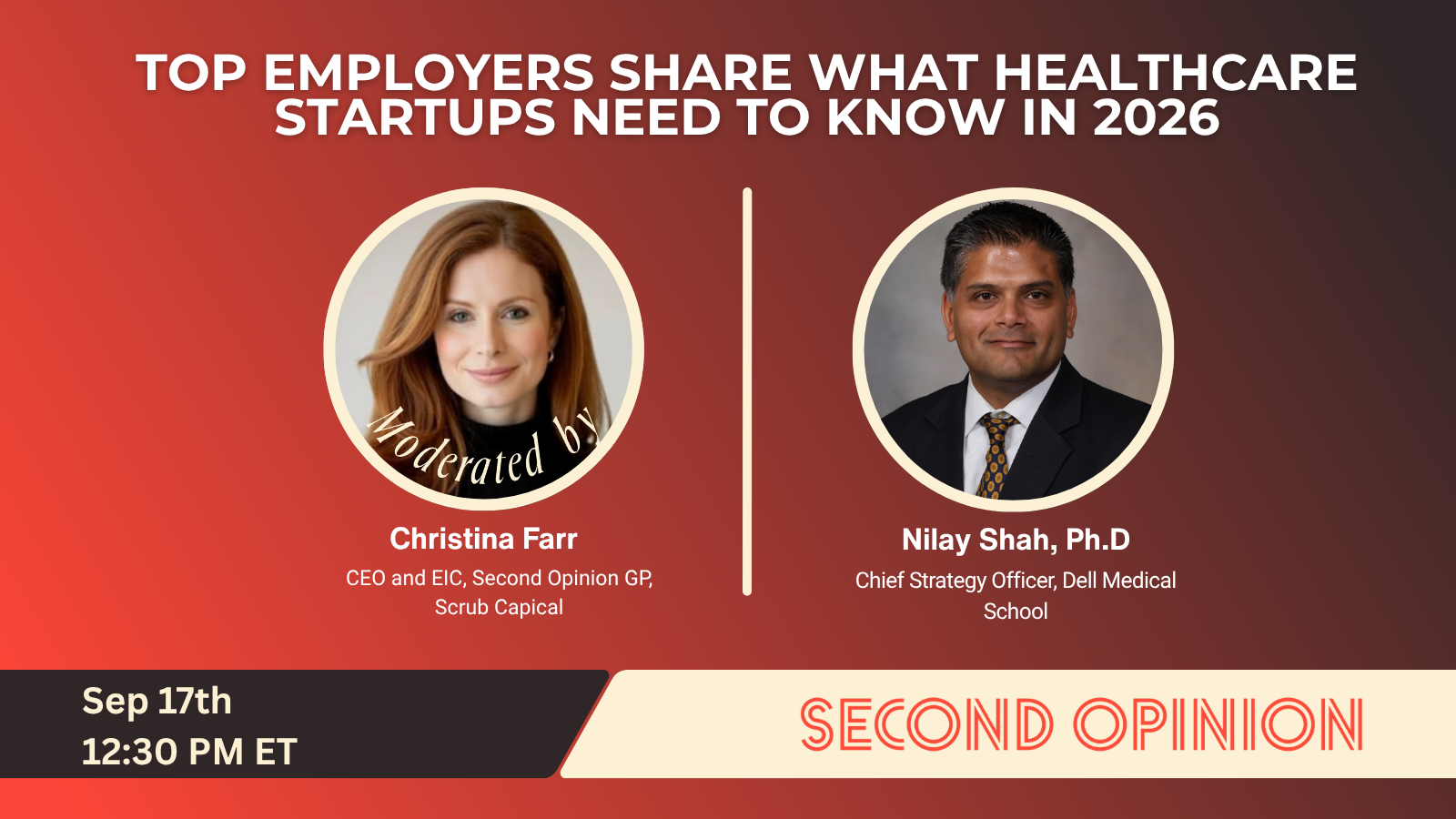
Top Employers Share What Healthcare Startups Need to Know in 2026
As enterprise health purchasers face volatile medical cost trends and tightening operational margins, the standard vendor pitch of "improved clinical efficiency&

Peptide Therapy: Where Do We Go From Here?
Watch the full webinar Peptide therapies have moved from niche biohacking circles into mainstream medicine, reshaping conversations around weight management, metabolic health,

Not everyone can access the top 1% of physicians. Will AI change that?
Historically, top-tier medical expertise was limited by wealth and geography. As AI reshapes healthcare delivery, a vital question emerges: can it democratize intelligence to give everyone access to the caliber of care typically reserved for the top 1%?

Privacy AI and the Future of HIPAA
Watch the Full Webinar As AI reshapes healthcare and more patient data flows beyond traditional clinical settings, the rules governing privacy, access,