

Five Lessons for Making AI Adoption Work
Editor’s note from Chrissy Farr Our inaugural Second Opinion Summit was an off the record event to promote candid discussions amongst the group. We will not be naming names in this piece to honor the spirit of privacy, but I invited our guest author to share some of her own observations. We’d also welcome hearing from you about how you’ve incorporated AI into your own company’s internal operations. What was clear from the panel discussion is everyone is finding benefit, while also making some of the same mistakes. Let’s get to it. |
By Nupur Srivastava Chief Operating Officer, Included Health |
Last week, I was lucky to be part of a curated group that attended the inaugural Second Opinion Summit. It was a great event, bringing together a diverse group of voices from across providers, payers, technology companies, investors, and patient communities.
Beyond simply being in the room, which was fun and interesting in its own right, I’ve spent the past week reflecting on the conversations around the panel I joined, “The AI Org Chart: What Happens to Healthcare Teams Now?”, alongside Sean Duffy of Omada Health, Abhinav Shashank of Innovaccer, and Guillaume de Zwirek of Artera, with Julie Ebert of Stifel moderating.
What’s refreshing is that the AI conversation is moving beyond humblebrag mentions of how an individual or business is using AI toward genuine discovery, sharing, and learning. I thought I’d share a few takeaways from the discussions I was part of.
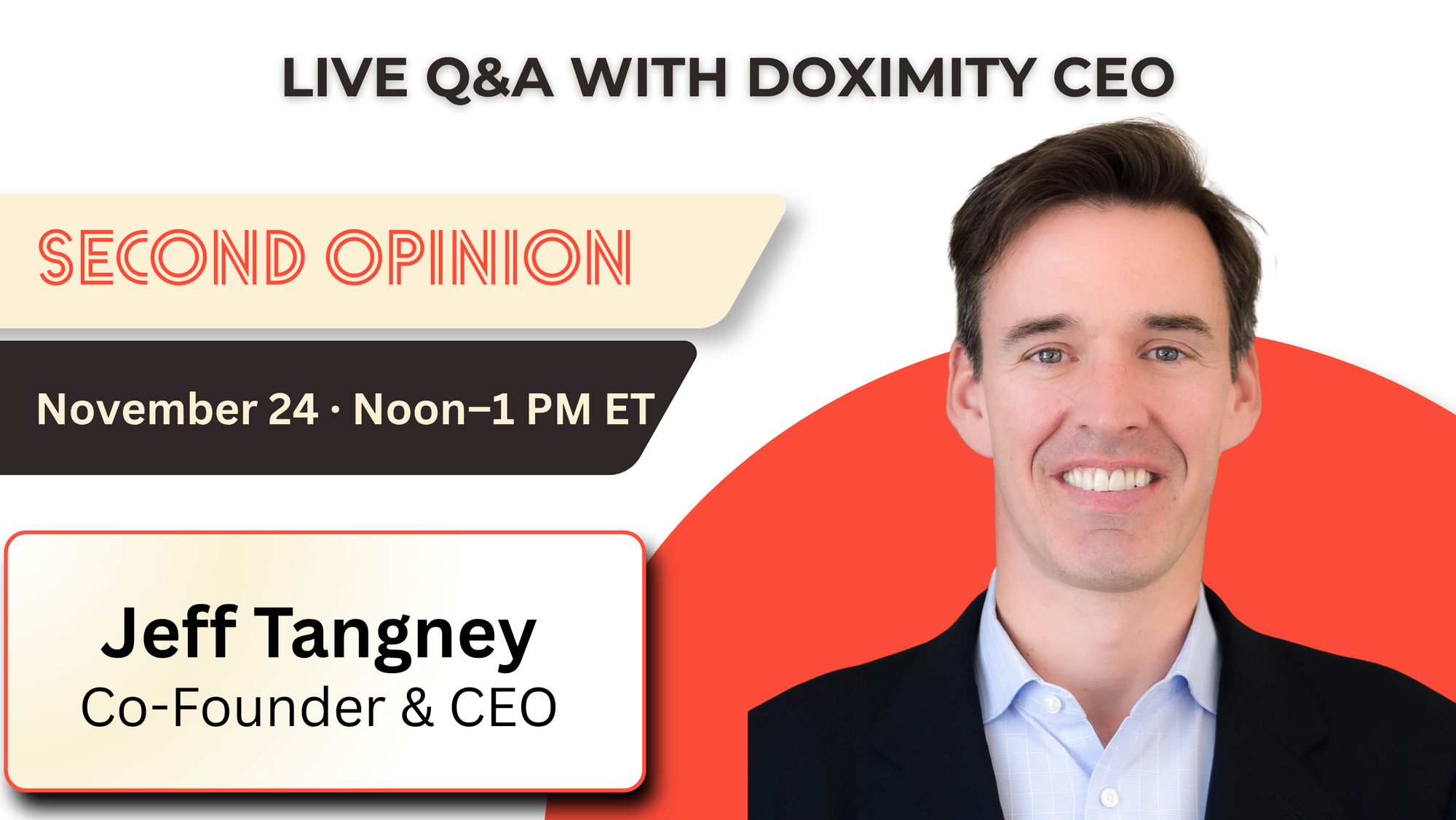 |
Coming up · November 24 · Noon–1 p.m. ET AMA with Doximity CEO Jeff Tangney A live Q&A on where clinicians are finding value with AI and building a company from zero to IPO. Co-hosted by Chrissy Farr and Rebecca Mitchell of Scrub Capital, for Second Opinion premium subscribers and Scrub Capital community members. |
1. AI adoption starts at the top
Included Health initially rolled out Glean, an enterprise AI platform for finding information and getting work done across company tools, by encouraging bottom-up experimentation and launching an AI Champions Network to help team members identify useful AI applications. That approach sparked excitement and adoption among employees across the company, though many still wanted a clearer direction of how AI could further be used. When adoption — measured by regular individual use of Glean — plateaued at around 70%, we shifted toward a stronger department-led approach. This remains a work in progress, but the goal is to go beyond individual efficiency and to task our leaders to rethink workflows and assess ROI at the team level as we combine AI, operational change, and human expertise to deliver higher-value work.
We’ve learned the two approaches are complementary: Bottom-up surfaces experimentation and builds momentum, while top-down sets clear expectations and priorities.
Product development is one area where I’ve seen this come to life. Rather than relying on individual product managers and designers to experiment on their own, a clearer mandate from Product and Engineering leaders is helping transform the product development lifecycle. We’ve moved past high-level encouragement and are now treating AI adoption as an active change-management effort. We’ve set a clear, standardized approach to integrating AI, are testing it through targeted pilots with early adopters, and are pairing structured training with dashboards so managers can be accountable for scaling what works. We’ve learned that strong AI adoption takes more than access to tools or even a mandate, alone. It also takes leaders who model the behavior, map a practical plan, and create a culture where teams are experimenting and learning together.
At Included Health, this is happening on an ongoing basis: Our head of product showed his team how he uses AI to scale his work; our head of engineering is exploring agentic coding herself constantly to stay current; and I recently built a chief-of-staff agent that’s already making a real difference for me — surfacing must-cover agenda items, flagging inconsistencies in what’s being said versus reported, reminding me and my team of things we say are priorities. In short, leaders need to walk the walk and make the learning visible.
`Upcoming Sessions
Live conversations with the people shaping healthcare.

AMA with Doximity CEO Jeff Tangney
Join Doximity CEO Jeff Tangney for a live Q&A on where clinicians are finding value with AI, how Doximity has evolved, and building a company from zero to IPO.

The Shift Left & the Impact of the Midterms on Healthcare
Democrats just took both chambers. Aneesh Chopra, Christopher Kerns and Mike Desjadon join Ruth Reader and Christina Farr live to talk through what they'll try to do on healthcare — and what's actually achievable under a Republican White House.

Is It Finally the Moment for Alternative Health Plans?
Register Here Employers are under growing pressure to control healthcare costs while improving access, outcomes, and the member experience. That has renewed

Type 2 Diabetes & Cardiometabolic Care: Wearables, AI & GLP-1s
Register Here The rise of wearables, GLP-1s, and AI is reshaping treatment for Type 2 diabetes, weight loss, and metabolic disease.

Verifying AI in Medicine: Is Healthcare AI Actually Ready for Deployment?
Is AI ready for real-world clinical care? Dr. Zak Kohane and Protege’s Engy Ziedan debate what it takes to safely trust AI in diagnosis and treatment, from benchmark performance and clinical evidence to whether we’re holding AI to a higher standard than humans.

Why Are Hospitals Hiring Chief AI Officers?
As AI moves from pilots into day-to-day healthcare operations, health systems are having to decide who should actually own the


Where are AI Agents Actually Working in Healthcare, and Why?
While the healthcare industry remains locked in a high-level debate over the theoretical potential of artificial intelligence, a select group of

Top Employers Share What Healthcare Startups Need to Know in 2026
As enterprise health purchasers face volatile medical cost trends and tightening operational margins, the standard vendor pitch of "improved clinical efficiency&

Peptide Therapy: Where Do We Go From Here?
Watch the full webinar Peptide therapies have moved from niche biohacking circles into mainstream medicine, reshaping conversations around weight management, metabolic health,