

How alternative are 'alternative' health plans, really?

Sponsored by  |
Paid content. Views are the author’s own. |
Back in January, I predicted (as did others) that 2026 would be the year of alternative plan design. Amid rising costs and consumer frustration with traditional insurance, it seemed inevitable that employers and employees would gravitate toward “alternative” plans pledging affordability, cost transparency, and simplicity — often powered by AI.
The prediction has mostly panned out. More than two-thirds of employers now offer an alternative plan or are considering adding one, with copay-only or dynamic copay plans driving much of the growth.
Alternative plans are suddenly mainstream, yet many large employers remain hesitant. When I talk to senior benefits leaders, I hear two themes: 1) their cost trend is unsustainable, and 2) they’re worried about untested models, unrealistic savings projections, and disruption for employees.
These competing concerns can paralyze plan sponsors. They know they need to overhaul their approach, but incumbents with legacy businesses to protect — including the carriers that own the largest “alternative plans” — have downplayed the need for change while playing up the risk of disruption.
Here’s what this looks like: I was recently at a meeting convened by a Fortune 50 employer that wanted to hear recommendations from its partners on innovative solutions to bring down costs. Sitting around the table were teams from a national carrier, a pharmacy benefits manager (PBM), and a third-party administrator (TPA).
I won’t detail the discussion, other than to say there was a lot of talk about administrative controls and healthcare by subtraction, and very little about how the partners might come together in new ways on behalf of our mutual client. As we were walking out, a colleague of mine — a former benefits consultant — remarked that the same meeting could have taken place 10 years ago.
This dynamic helps explain why most alternative plans amount to little more than a better “shopping” experience wrapped in an AI-first app. The packaging is new, and the plan names are definitely cuter, but the same-old networks and misaligned incentives remain.
`
Upcoming Sessions
Live conversations with the people shaping healthcare.

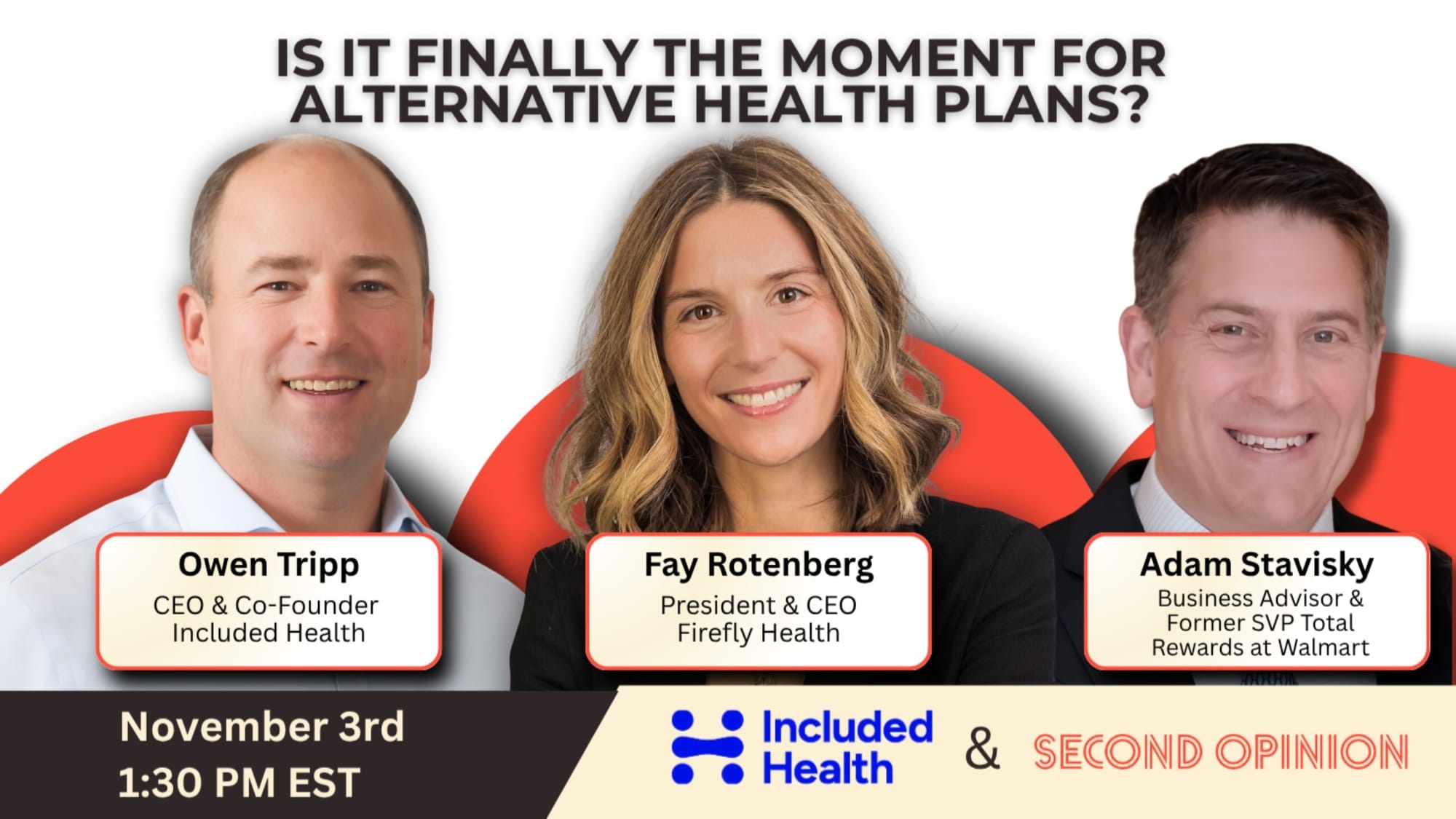
Is It Finally the Moment for Alternative Plan Design?
Employers are under growing pressure to control healthcare costs while improving access, outcomes, and the member experience. That has renewed interest in

Type 2 Diabetes & Cardiometabolic Care: Wearables, AI & GLP-1s
The rise of wearables, GLP-1s, and AI is reshaping treatment for Type 2 diabetes, weight loss, and metabolic disease. We have

Verifying AI in Medicine: Is Healthcare AI Actually Ready for Deployment?
Is AI ready for real-world clinical care? Dr. Zak Kohane and Protege’s Engy Ziedan debate what it takes to safely trust AI in diagnosis and treatment, from benchmark performance and clinical evidence to whether we’re holding AI to a higher standard than humans.

Why Are Hospitals Hiring Chief AI Officers?
As AI moves from pilots into day-to-day healthcare operations, health systems are having to decide who should actually own the


Where are AI Agents Actually Working in Healthcare, and Why?
While the healthcare industry remains locked in a high-level debate over the theoretical potential of artificial intelligence, a select group of

Top Employers Share What Healthcare Startups Need to Know in 2026
As enterprise health purchasers face volatile medical cost trends and tightening operational margins, the standard vendor pitch of "improved clinical efficiency&

Peptide Therapy: Where Do We Go From Here?
Watch the full webinar Peptide therapies have moved from niche biohacking circles into mainstream medicine, reshaping conversations around weight management, metabolic health,

Not everyone can access the top 1% of physicians. Will AI change that?
Historically, top-tier medical expertise was limited by wealth and geography. As AI reshapes healthcare delivery, a vital question emerges: can it democratize intelligence to give everyone access to the caliber of care typically reserved for the top 1%?

Privacy AI and the Future of HIPAA
Watch the Full Webinar As AI reshapes healthcare and more patient data flows beyond traditional clinical settings, the rules governing privacy, access,