

Trudging towards interoperability


This week I reported that the next wave of interoperability regulation is coming soon, and it likely won't include the originally proposed changes to information blocking.
The Office of the National Coordinator for Health Information Technology wants to crack down on an illegal practice wherein holders of health data restrict access to it unnecessarily. It's called information blocking and it's a real problem for the entire health care industry. All those cool things that AI and tech companies want to do in health care? They need data.
Accessing health data—as anyone in this industry will tell you—is hard. ONC knows this. The head of the agency, Thomas Keane, has repeatedly promised that the Department of Health and Human Services is going to take action against information blockers. Violators of information blocking stand to lose $1 million per violation.
As part of its war on info blocking, ONC proposed advancing some new definitions within information blocking and removing some exceptions to the rule. But that proposal was met with aggressive pushback (you can read about it here).
I asked “API Guy” Brendan Keeler what he thought about the news. He pointed to a letter the Electronic Health Record Association sent to ONC in February, noting that the agency failed to put together an analysis on how much the regulation would financially impact the industry—a procedural error.
“When you say something like that, you're saying, ‘Hey, don't do this’,” he said. The letter implies, but does not say, that if the proposal had gone forward as written, there would have been an opportunity for legal action (which Keeler wrote about here).
Assessing the news for myself, I am struck by how difficult it must be for ONC to achieve true interoperability with the authorities it has. “Correct conclusion,” Keeler agreed. “You squint at it and ‘you're like, oh my god, how do we ever get anything done?’”
And yet, he's optimistic. “Every EHR is absolutely frightened of being sued and kind of does what you want if you ask,” he says. Information blocking still very much exists, but he thinks there's increasing pressure—via lawsuits and federal scrutiny—to share data.
“The more pressure that's on them, the more we're going to see investments into APIs and controlled [robotic process automation] programs,” he said.
And now, on to the news!
— Ruth

|
17 · SEP · 1:00PM ET Top Employers Share What Healthcare Startups Need to Know in 2026Top employers reveal how healthcare startups can win enterprise buyers, with Nilay Shah sharing procurement priorities, purchasing decisions, outreach strategies, and ROI expectations.
|
|
|
24 · SEP · 12:00PM ET Healthcare AI Has an ROI ProblemJoin Aaron Miri, DHA, FCHIME, CHCIO, EVP and Chief Digital & Information Officer at Baptist Health, to explore how health systems evaluate AI ROI, overcome data bottlenecks, and scale emerging technology into clinical production.
|
|
|
22 · SEP · 3:30PM ET Where are AI Agents Actually Working in Healthcare, and Why?Christina Farr joins Nick Perry (Candid Health) and Robert Krayn (Talkiatry) to explore how autonomous AI agents are driving measurable financial outcomes, from billing to faster cash cycles and growth.
|
|
|
13 · OCT · 12:30PM ET Verifying AI in Medicine: Is Healthcare AI Actually Ready for Deployment?Is AI ready for real-world clinical care? Dr. Zak Kohane and Protege’s Engy Ziedan debate what it takes to safely trust AI in diagnosis and treatment, from benchmark performance and clinical evidence to whether we’re holding AI to a higher standard than humans.
|
|
`
Upcoming Sessions
Live conversations with the people shaping healthcare.

Verifying AI in Medicine: Is Healthcare AI Actually Ready for Deployment?
Is AI ready for real-world clinical care? Dr. Zak Kohane and Protege’s Engy Ziedan debate what it takes to safely trust AI in diagnosis and treatment, from benchmark performance and clinical evidence to whether we’re holding AI to a higher standard than humans.

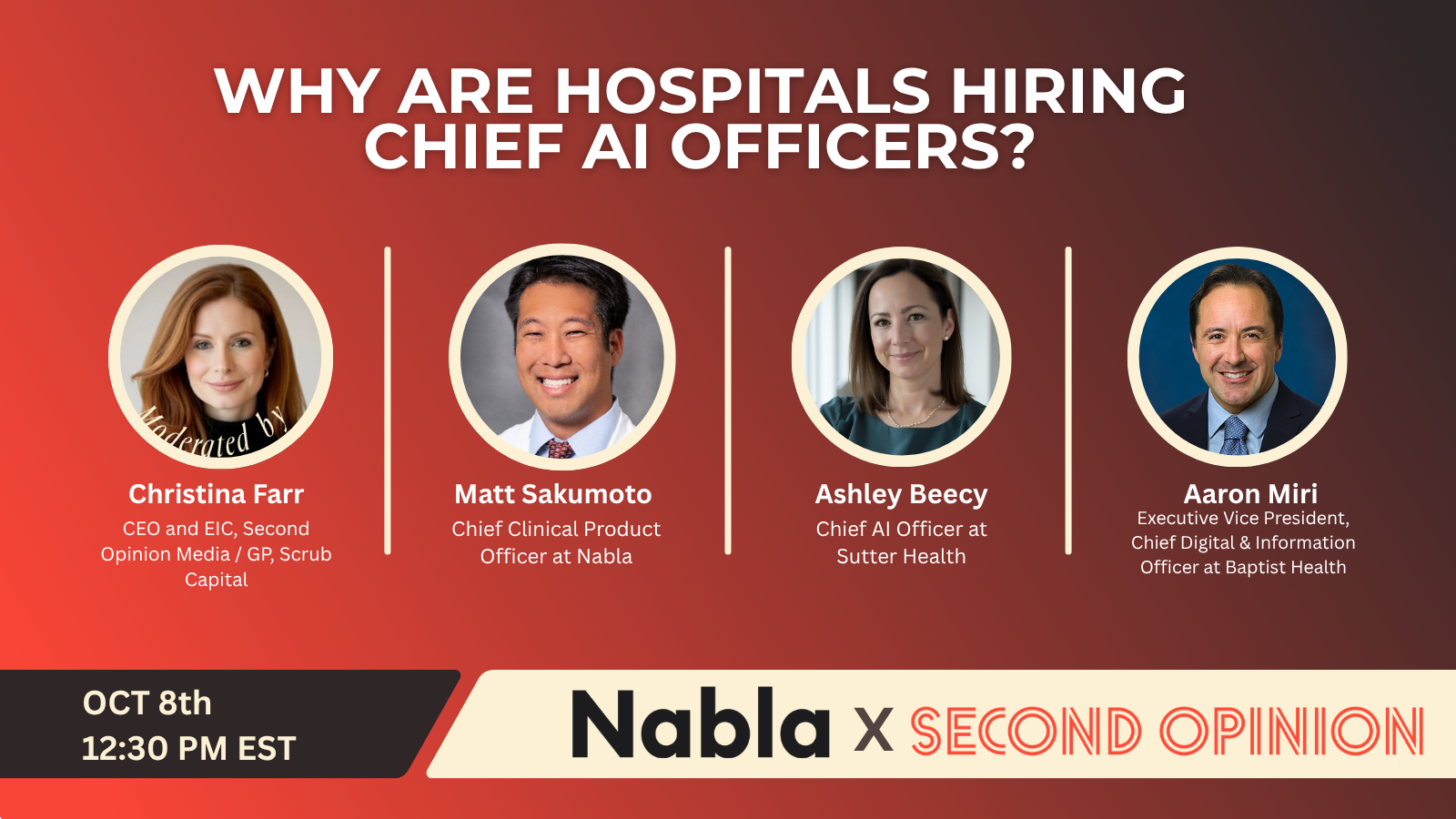
Why Are Hospitals Hiring Chief AI Officers?
As AI moves from pilots into day-to-day healthcare operations, health systems are having to decide who should actually own the


Where are AI Agents Actually Working in Healthcare, and Why?
While the healthcare industry remains locked in a high-level debate over the theoretical potential of artificial intelligence, a select group of

Top Employers Share What Healthcare Startups Need to Know in 2026
As enterprise health purchasers face volatile medical cost trends and tightening operational margins, the standard vendor pitch of "improved clinical efficiency&

Peptide Therapy: Where Do We Go From Here?
Watch the full webinar Peptide therapies have moved from niche biohacking circles into mainstream medicine, reshaping conversations around weight management, metabolic health,

Not everyone can access the top 1% of physicians. Will AI change that?
Historically, top-tier medical expertise was limited by wealth and geography. As AI reshapes healthcare delivery, a vital question emerges: can it democratize intelligence to give everyone access to the caliber of care typically reserved for the top 1%?

Privacy AI and the Future of HIPAA
Watch the Full Webinar As AI reshapes healthcare and more patient data flows beyond traditional clinical settings, the rules governing privacy, access,

What will AI do for employer healthcare and benefits?
Employer healthcare may be one of the most practical — and overlooked — proving grounds for AI.

Hospitals as the new go-to-market, lessons from the trenches
Watch the Full Webinar Health systems are entering a new frontier, one where innovation isn’t optional, and meaningful change requires creativity,