

The TLDR on UGM


Health system executives and developers made the journey to Verona, Wisconsin, this week to hear what new products the electronic health record behemoth will be launching.
This year’s annual User Group Meeting was more show than tell. Last year, the company made several announcements about AI products, including, controversially, a decision to launch its own ambient scribe. Now the company is showing off its progress. Epic demonstrated how its bots Emmie (for patient questions), Penny (revenue cycle management), and Art (clinician assistant) can collaborate, including through Ergo Visit, which prepares clinicians for outpatient visits.
It also started rolling out its Agent Factory, which will allow health systems to create their own custom bots. And health systems are vetting Curiosity, a generative AI that it built off its COSMOS research platform.
Other key announcements:
— Faster diagnostic imaging exchange
— Real-time prior authorization
— A way to take payments without needing a third party payment provider, which Brendan Keeler called out to me as an underrated announcement.
Controversy: The annual meeting comes amid an alleged federal probe into Epic’s anti-competitive behavior. The reporting represents a new layer in an on-going debate as to whether Epic is behaving anticompetitively or protecting its customers and their data.
Texas attorney general Ken Paxton sued the company in December 2025. It is also being sued by health record rival Particle Health. Both allege Epic adopts practices, through as fees and specific restrictions, with the aim of shutting down its competition. Epic, along with several of its clients, has also sued several telehealth companies alleging that they fraudulently accessed patient data on public health data networks, essentially asserting that these networks and frameworks are not secure.
In April, I spoke with Sharona Hoffman, professor of law and bioethics at Case Western Reserve University, about Epic's vendor services agreement, which third parties sometimes need to sign when they work with Epic’s hospital clients. She pointed out ways in which the agreement heavily favored Epic. The company told me it has since updated language in that agreement and removed certain provisions.
At the same time that questions around how the company handles competition are arising, Epic is having a changing of the guard. Epic’s former President Sumit Rana announced stepping down at the company earlier this summer, though he will be an advisor to Epic’s Board of Directors. Following his announcement, Second Opinion first reported several other key departures including: Seth Hain, Drew McCombs, and Dave Fuhrmann. All were supportive of building Epic into a more collaborative ecosystem, I’m told.
A key question about Epic’s future, and something I’ll be watching, as its new leadership structure solidifies and it continues to roll out more advanced capabilities and tools, is how it plays with competing products. I’ll be reporting on this and encourage you to send tips.
—Ruth

|
17 · SEP · 1:00PM ET Top Employers Share What Healthcare Startups Need to Know in 2026Top employers reveal how healthcare startups can win enterprise buyers, with Nilay Shah sharing procurement priorities, purchasing decisions, outreach strategies, and ROI expectations.
|
|
|
24 · SEP · 12:00PM ET Healthcare AI Has an ROI ProblemJoin Aaron Miri, DHA, FCHIME, CHCIO, EVP and Chief Digital & Information Officer at Baptist Health, to explore how health systems evaluate AI ROI, overcome data bottlenecks, and scale emerging technology into clinical production.
|
|
|
13 · OCT · 12:30PM ET Verifying AI in Medicine: Is Healthcare AI Actually Ready for Deployment?Is AI ready for real-world clinical care? Dr. Zak Kohane and Protege’s Engy Ziedan debate what it takes to safely trust AI in diagnosis and treatment, from benchmark performance and clinical evidence to whether we’re holding AI to a higher standard than humans.
|
|
Upcoming Sessions
Live conversations with the people shaping healthcare.

Is It Finally the Moment for Alternative Plan Design?
Employers are under growing pressure to control healthcare costs while improving access, outcomes, and the member experience. That has renewed interest in

Type 2 Diabetes & Cardiometabolic Care: Wearables, AI & GLP-1s
The rise of wearables, GLP-1s, and AI is reshaping treatment for Type 2 diabetes, weight loss, and metabolic disease. We have

Verifying AI in Medicine: Is Healthcare AI Actually Ready for Deployment?
Is AI ready for real-world clinical care? Dr. Zak Kohane and Protege’s Engy Ziedan debate what it takes to safely trust AI in diagnosis and treatment, from benchmark performance and clinical evidence to whether we’re holding AI to a higher standard than humans.

Why Are Hospitals Hiring Chief AI Officers?
As AI moves from pilots into day-to-day healthcare operations, health systems are having to decide who should actually own the


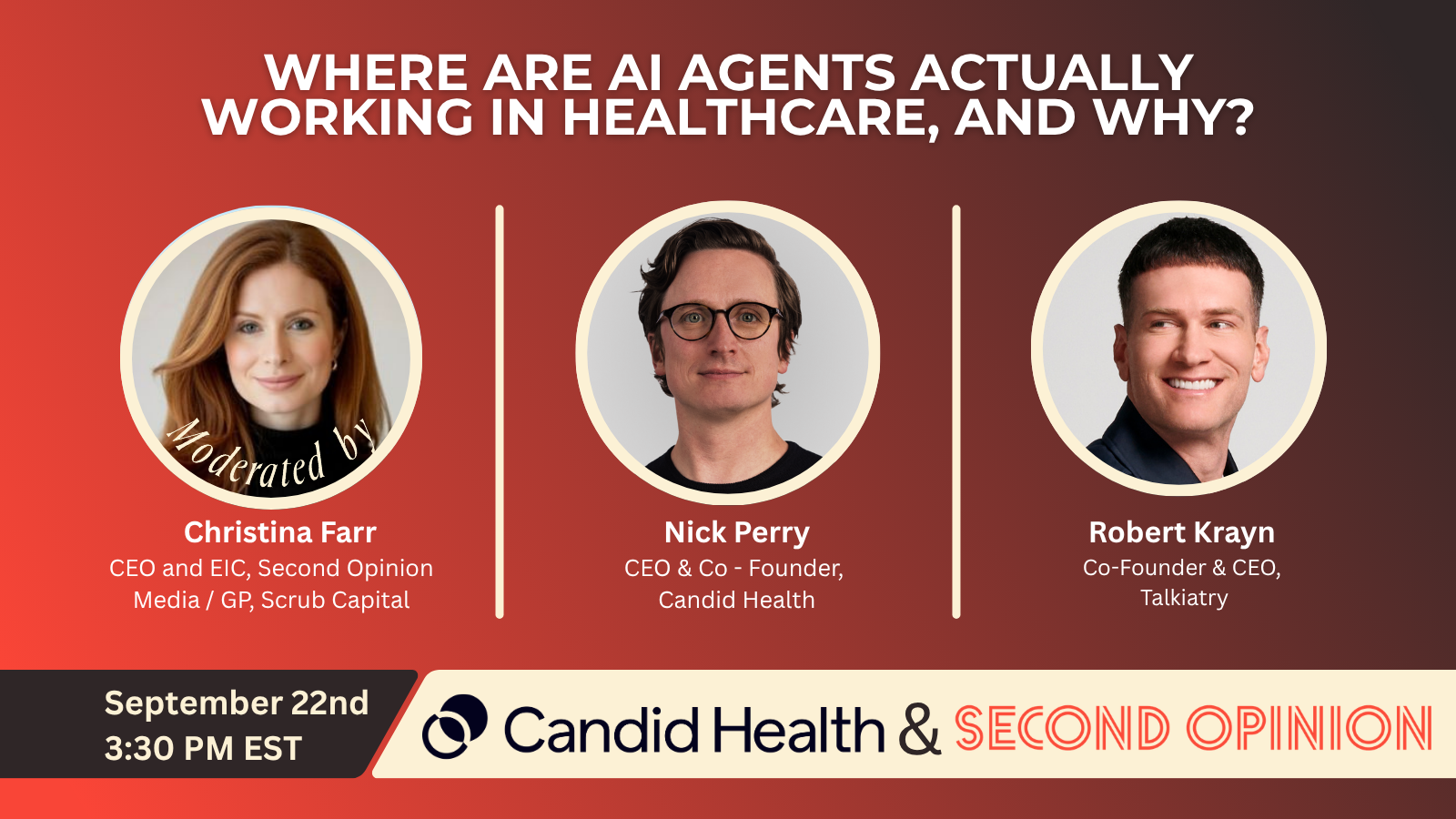
Where are AI Agents Actually Working in Healthcare, and Why?
While the healthcare industry remains locked in a high-level debate over the theoretical potential of artificial intelligence, a select group of

Top Employers Share What Healthcare Startups Need to Know in 2026
As enterprise health purchasers face volatile medical cost trends and tightening operational margins, the standard vendor pitch of "improved clinical efficiency&

Peptide Therapy: Where Do We Go From Here?
Watch the full webinar Peptide therapies have moved from niche biohacking circles into mainstream medicine, reshaping conversations around weight management, metabolic health,

Not everyone can access the top 1% of physicians. Will AI change that?
Historically, top-tier medical expertise was limited by wealth and geography. As AI reshapes healthcare delivery, a vital question emerges: can it democratize intelligence to give everyone access to the caliber of care typically reserved for the top 1%?

Privacy AI and the Future of HIPAA
Watch the Full Webinar As AI reshapes healthcare and more patient data flows beyond traditional clinical settings, the rules governing privacy, access,