

Trudging towards interoperability


This week I reported that the next wave of interoperability regulation is coming soon, and it likely won't include the originally proposed changes to information blocking.
The Office of the National Coordinator for Health Information Technology wants to crack down on an illegal practice wherein holders of health data restrict access to it unnecessarily. It's called information blocking and it's a real problem for the entire health care industry. All those cool things that AI and tech companies want to do in health care? They need data.
Accessing health data—as anyone in this industry will tell you—is hard. ONC knows this. The head of the agency, Thomas Keane, has repeatedly promised that the Department of Health and Human Services is going to take action against information blockers. Violators of information blocking stand to lose $1 million per violation.
As part of its war on info blocking, ONC proposed advancing some new definitions within information blocking and removing some exceptions to the rule. But that proposal was met with aggressive pushback (you can read about it here).
I asked “API Guy” Brendan Keeler what he thought about the news. He pointed to a letter the Electronic Health Record Association sent to ONC in February, noting that the agency failed to put together an analysis on how much the regulation would financially impact the industry—a procedural error.
“When you say something like that, you're saying, ‘Hey, don't do this’,” he said. The letter implies, but does not say, that if the proposal had gone forward as written, there would have been an opportunity for legal action (which Keeler wrote about here).
Assessing the news for myself, I am struck by how difficult it must be for ONC to achieve true interoperability with the authorities it has. “Correct conclusion,” Keeler agreed. “You squint at it and ‘you're like, oh my god, how do we ever get anything done?’”
And yet, he's optimistic. “Every EHR is absolutely frightened of being sued and kind of does what you want if you ask,” he says. Information blocking still very much exists, but he thinks there's increasing pressure—via lawsuits and federal scrutiny—to share data.
“The more pressure that's on them, the more we're going to see investments into APIs and controlled [robotic process automation] programs,” he said.
And now, on to the news!
— Ruth

|
17 · SEP · 1:00PM ET Top Employers Share What Healthcare Startups Need to Know in 2026Top employers reveal how healthcare startups can win enterprise buyers, with Nilay Shah sharing procurement priorities, purchasing decisions, outreach strategies, and ROI expectations.
|
|
|
24 · SEP · 12:00PM ET Healthcare AI Has an ROI ProblemJoin Aaron Miri, DHA, FCHIME, CHCIO, EVP and Chief Digital & Information Officer at Baptist Health, to explore how health systems evaluate AI ROI, overcome data bottlenecks, and scale emerging technology into clinical production.
|
|
|
22 · SEP · 3:30PM ET Where are AI Agents Actually Working in Healthcare, and Why?Christina Farr joins Nick Perry (Candid Health) and Robert Krayn (Talkiatry) to explore how autonomous AI agents are driving measurable financial outcomes, from billing to faster cash cycles and growth.
|
|
|
13 · OCT · 12:30PM ET Verifying AI in Medicine: Is Healthcare AI Actually Ready for Deployment?Is AI ready for real-world clinical care? Dr. Zak Kohane and Protege’s Engy Ziedan debate what it takes to safely trust AI in diagnosis and treatment, from benchmark performance and clinical evidence to whether we’re holding AI to a higher standard than humans.
|
|
ŌURA filed for IPO
The maker of the smart ring submitted an SEC registration statement relating to its intention of offering shares on the Nasdaq market, where they would be traded with the ticker OURA. Shares and price range have yet to be shared, though analysts say the listing may aim for a valuation north of $16 billion.
The company is experiencing impressive growth, with income of $60.8 million for the nine months ended June 30, compared with $1.6 million in the same period a year earlier, and total revenue of $1.21 billion, a 74% increase year over year.
Democrats call for the end of ER data sharing with Konza Health
Democrats are calling for the Trump administration to suspend the NEISS-R program from the Consumer Product Safety Commission, which pressured hospitals to share identifiable emergency room health data with Konza Health, a private non-profit interoperability company. The program was initially mandatory, but the agency has backtracked after a KFF Health News investigation, and is now calling it voluntary.
OpenEvidence is moving further into oncology
OpenEvidence announced an upcoming partnership with a “nationally leading cancer center” (soon to be unveiled) that integrates precision oncology and genomic analysis into the AI platform, already used by millions of doctors. The move builds on OpenEvidence's existing licensing agreements with the National Comprehensive Cancer Network and the American Society of Clinical Oncology to embed evidence-based cancer treatment guidelines into its medical search engine.
THE BIG PICTURE
Defenders of the increasing vertical integration of health care services say that consolidation will create cost efficiencies that could bring down the cost of care. Elisabeth Rosenthal, former editor in chief of Kaiser Health News, has done the numbers and reports that when health care supply chains are merged, providers can force patients into more expensive care against their will. Anti-trust laws may not be enough to tackle the issue.
Forus, an AI network that automates the path between prescription and starting treatment (navigating insurance, prior authorization, and supply chain), raised $150 million in Series C financing at a $3 billion valuation, tripling its Series B valuation just months earlier. Bain Capital Ventures led the round. Total funding now exceeds $300 million.
EZ Health, a senior-care startup, emerged from stealth with $26 million in funding. The company provides seniors with an AI-assisted care navigator by phone that analyzes medical records, surfaces problems, and finds local resources covered by Medicare with physician certification. EZ Health raised $21 million in a seed round in May 2026, plus $5 million in pre-seed, with investors including Primary Ventures and Construct Capital.
PatientIQ, a healthcare outcomes intelligence platform, raised $30 million in Series C financing led by Chicago-based private equity firm Hughes & Company.
GenHealth.ai, an AI startup deploying agents into provider offices to reduce administrative burden, secured $16.5 million in Series A funding led by Flare Capital Partners.
Scan.com, a medical imaging platform, secured $220 million in combined equity and debt financing to build what it calls the largest imaging network in the U.S. The $90 million Series C equity round was led by Noteus Partners, alongside $130 million in debt facilities from VerisFi Capital and Atempo Growth.
AI-native radiology practice Epsilon Health raised $20 million, according to an Axios exclusive.
Cureety, a precision oncology care company, acquired Reimagine Care, an AI-driven oncology care organization and 2025 Fierce 15 honoree whose platform offers 24/7 virtual triage via an AI assistant called Remi. The combined companies now support more than 250 cancer centers covering over 100,000 patients across five countries. The terms of the deal were not disclosed.
Direct-to-consumer peptide platform System raised $20 million in new funding from Patron Fund and others, highlighting the booming interest in the peptide market.
Employers Health and Judi Health are partnering to launch StarkRx, a cost-plus benefit offering that provides employers with transparency and opportunity to lower drug costs.
Quel Health is launching a GLP-1 for addiction treatment platform. Executives are calling it the “first national telehealth company” built around GLP-1, though they also note that the drugs haven't received approval for treatment of addiction, despite being used off-label for it.
Neel Shah, who up until recently was chief medical officer at women's virtual health clinic Maven, has left the company for an ambitious project: cut the maternal death rate in half within five years. He now serves as the President of Healthy Moms, Healthy Babies.
Jeremy Walsh, who previously led AI efforts inside of the Food and Drug Administration, has joined Google DeepMind as a director.
Send us your burning questions!
We want to launch a new advice column for Second Opinion readers. What questions are you dying to ask the Second Opinion community, high-level executives, or another founder?
You can send your questions here.
This Week on Lifers
Christina Farr sits down with Peter Lee, President of Microsoft Science, and Dr. Christopher Longhurst, the new CEO of Seattle Children's, to take stock of where AI in healthcare actually stands versus where the headlines say it is. They get into why ambient scribes still haven't produced a clean financial win, Chris's prediction that within three to five years a physician assistant augmented by AI may practice at the level of the best general pediatrician, and the three Cs he argues will keep humans in the loop: competence, communication, and character. Peter closes on the risk he worries about most, which is people using AI to hide from accountability on consequential decisions. Dive into the Granola notes from this episode: https://notes.granola.ai/t/54b78860-b...
Four Questions with Jennifer Goldsack
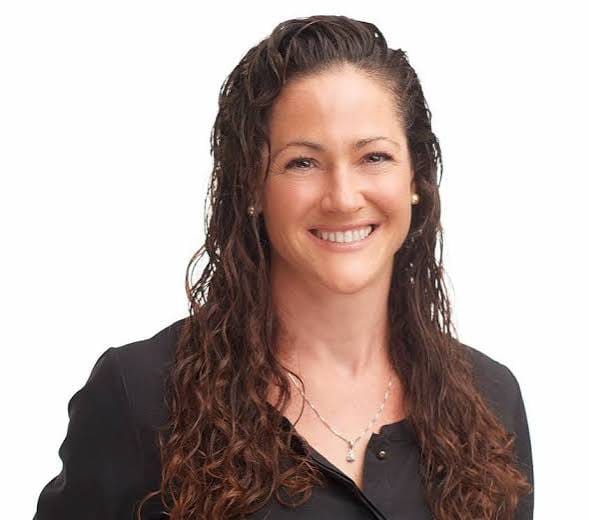
Jennifer Goldsack: What I find really exciting about this moment, is the rate of acceleration of AI-enabled technologies in particular. But that doesn't take away from the importance of things like remote monitoring and virtual care. You know, we mustn't forget those things because that allows us to communicate. That allows us to monitor beyond the walls of the clinic. But the the pace of the technological innovation, the dollars flowing into it, the policy environment With very, very, I think, intentional efforts being made by CMS to accelerate the use of technology, and then you posted a very good conversation just last week on the discourse within professional communities about what all of these tools and technologies mean for the industry that exists to care for people. This is a moment where the AMA has the positioning, the credibility, and under John's leadership, the will to really lead in this moment. And I think it's really important that we take an evidenced-based approach to evaluating the rapidly changing landscape and make sure that we are neither falling behind the promise of these tools to support patients and the people who care for them, nor are we getting ahead. And I think that you know, frankly, the resources that AMA is going to commit to being the leader in this space, the community that they represent-it's-I'm simply really excited because I believe that there's an opportunity now to have a lasting impact to make sure that in this moment of change we get things right again for the patients that this entire industry exists to care for.
Ruth Reader: The AMA has had other digital health efforts in the past, I'm curious what you think this center is uniquely positioned to do, and why it is?
Jennifer Goldsack: AMA is incredibly influential both to and on behalf of its position members and then to the field more broadly, and so what made me really excited about the formalization of AMA's efforts in digital, enshrined in this Center for Digital Health and AI, is that it's a clear signal that it's a priority with an intention to dedicate resources to truly lead here and become a center of excellence, both as an internal resource to the rest of the AMA and all of their activities, as well as the membership, with access to everything like education, but also to the industry more broadly, being that conduit between the best of technology, what physicians deeply know to be true around what it means to care for people, the proximity to being able to educate as it relates to policy opportunities, to make sure that we are taking the best approach to caring for people as these technologies come fit and fast. What you and I know to be true, Ruth, is that there's no single pathway or silver bullet to getting this right. We have to think about everything from scope of practice to the trustworthiness of the tool to the licensure to what is layered in with the AI-enabled solutions themselves: whether that's data rights, data privacy, and data exchange; whether we think about the the data that's captured outside of the wards of the clinic, either in patients' homes or during their activities of daily living; whether it's how we communicate with patients beyond the wards of the clinic— all of this has to be put together. We need to think about: how do we need to support physicians and other clinical experts? How do we think about the legal pieces? How do we think about the policy environment that we need to optimize this? How do we think about clinical workflows and payment pathways? All of these things need to be contemplated, and that's something that AMA deeply understands, is willing to resource, and gets to benefit from the deep expertise and knowledge across the rest of AMA. That has been that focus of digital expertise to AMA more broadly. So, in my mind, there's this phenomenal synergy between these things. What we can do with the physician community, with the organization, and then how we can lead-not just nationally, but internationally.
Ruth Reader: Do you feel an urgency to do this work?
Jennifer Goldsack: Absolutely, and really not because of the technology, because far too many people cannot access the care they need, and that's the company getting a lot. And what was due to we know this. We're looking at 9% hikes in premiums this year. We're looking at, you know, a workforce that is not sufficiently well supported to respond to the needs of the patients that it exists to care for. There is an absolute urgency, but it's being driven by the fact that there are plenty of patients out there who need the support of the healthcare system, but who aren't able to for financial reasons or due to a bit of location or other challenges, and cannot access their care. Then, at the same time, we have this suite of powerful new technologies that are coming towards us with this enormous problem. We have to make sure that we deploy those technologies in a way that we are absolutely certain is helping and not harming. And the debate that you were covering, I think it's fantastic that there's a discourse on this, but it can't be about an opinion. It has to be that we are absolutely certain with evidence, what works best for the patients. The center is the first step in the process. Because I want with the full support of the center what good actually looks like, both with today's technologies and into the future. It cannot be done on opinion.
Ruth Reader: What becomes of DIME, the organization you co-founded?
Jennifer Goldsack: Ben Van Den Brief, who has been our president and chief scientific officer for several years now is absolutely phenomenal, and so he is stepping into the [CEO] role today. He has my full support, the full support of the board. The organization is really excited. One of the things I'm most proud of is: it's one thing to do great work and build discrete resources and impact, and we've certainly done that at DIME. But I'm incredibly proud that with our community, with the team at DIME, with our board, we've really built something that is much bigger than one person, and that will absolutely endure beyond my tenure. And I think Ben's vision could continue to sit at the intersection of care delivery and medical product development, and be really intentional about supporting the organizations in the field working every day to improve the way we care for people in the digital era. I'll be staying on the board, but with absolutely no formal operational role.
Upcoming Sessions
Live conversations with the people shaping healthcare.

Verifying AI in Medicine: Is Healthcare AI Actually Ready for Deployment?
Is AI ready for real-world clinical care? Dr. Zak Kohane and Protege’s Engy Ziedan debate what it takes to safely trust AI in diagnosis and treatment, from benchmark performance and clinical evidence to whether we’re holding AI to a higher standard than humans.

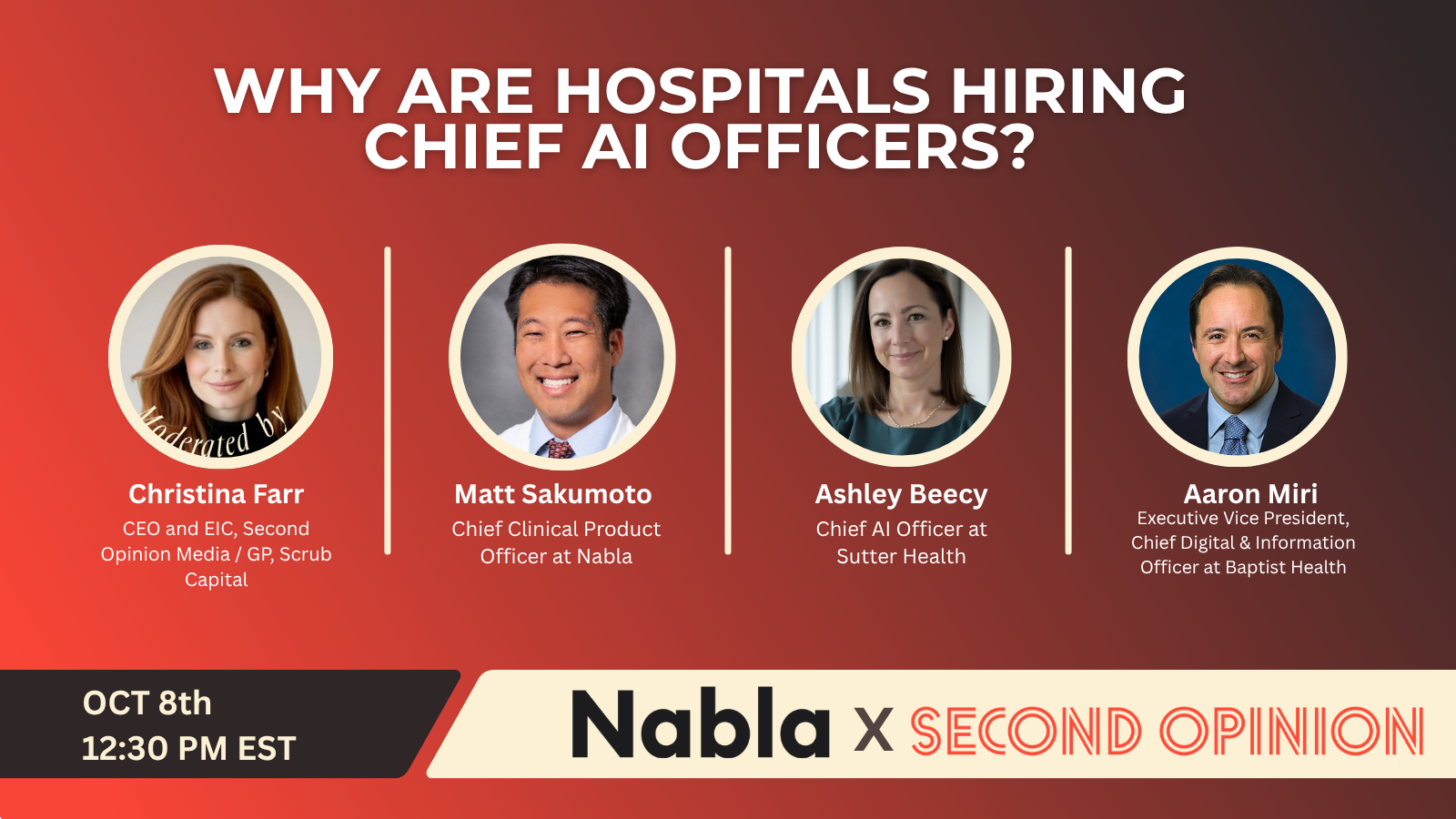
Why Are Hospitals Hiring Chief AI Officers?
As AI moves from pilots into day-to-day healthcare operations, health systems are having to decide who should actually own the


Where are AI Agents Actually Working in Healthcare, and Why?
While the healthcare industry remains locked in a high-level debate over the theoretical potential of artificial intelligence, a select group of

Top Employers Share What Healthcare Startups Need to Know in 2026
As enterprise health purchasers face volatile medical cost trends and tightening operational margins, the standard vendor pitch of "improved clinical efficiency&

Peptide Therapy: Where Do We Go From Here?
Watch the full webinar Peptide therapies have moved from niche biohacking circles into mainstream medicine, reshaping conversations around weight management, metabolic health,

Not everyone can access the top 1% of physicians. Will AI change that?
Historically, top-tier medical expertise was limited by wealth and geography. As AI reshapes healthcare delivery, a vital question emerges: can it democratize intelligence to give everyone access to the caliber of care typically reserved for the top 1%?

Privacy AI and the Future of HIPAA
Watch the Full Webinar As AI reshapes healthcare and more patient data flows beyond traditional clinical settings, the rules governing privacy, access,

What will AI do for employer healthcare and benefits?
Employer healthcare may be one of the most practical — and overlooked — proving grounds for AI.

Hospitals as the new go-to-market, lessons from the trenches
Watch the Full Webinar Health systems are entering a new frontier, one where innovation isn’t optional, and meaningful change requires creativity,